Scope
- Policy Statement
Speak up; we will listen
- The Policy
Obligations on Staff to Report Abuse
Investigating and Dealing with Allegations
Dealing with Interference with or Victimisation of Staff who Report Abuse
What Concerns can be Raised
Unjustified Reporting
Confidentiality
- Related Policies
- Related Guidance
- Training Statement
Policy Statement
Whistleblowing is the term used when someone who works for an employer raises a concern about bad practice or risk, e.g. to a person’s safety, wrongdoing that harms, or creates a risk to harm to people who use the service, colleagues or the wider public.
This organisation’s policy on whistleblowing sets out to comply, in every aspect, with the Public Interest Disclosure Act 1998 in protecting and not the victimising of staff who seek to report, and who have investigated genuine and reasonable concerns about any form of malpractice that they encounter in their work.
At the same time, the company aims to create an atmosphere of open communication and commitment to high standards of work, within which criticisms can be frankly made and thoroughly investigated.
This organisation also recommends that its staff make arrangements to have access to independent legal advice in the event of any involvement in allegations as whistleblowers or as people against whom allegations are made. They are encouraged to do this through membership of a trade union or professional organisation that includes legal advice as part of its services.
Speak up; we will listen
Speaking up about any concerns you have at work is important. It is vital because it will help us to keep improving our services for all service users and the working environment for the staff.
You may feel worried about raising a concern, and we understand this but please do not be put off. Following our duty of candour, our senior management is committed to an open and honest culture. We will look into what you say and you will always have access to the support you need.
The Policy
This document outlines the organisation’s policy for responding to allegations or reports of abuse of service users, and other forms of misconduct, made by one or more members of staff against other staff. These actions are known as whistleblowing.
The requirement for such a policy arises because it was previously the case that management considered individuals involved in whistleblowing as troublemakers. It is now legally recognised that staff who are in a position to observe and report bad practice should be enabled to do so without fear of repercussions on their conduct and career prospects. Indeed, failure to report malpractice could lead to accusations of colluding in it, and therefore of being guilty of misconduct.
Obligations on Staff to Report Abuse
The organisation requires its entire staff to observe the organisation’s work and report diligently on anything that causes them concern. We believe that teamwork and loyalty to colleagues should not be allowed to deter staff from reporting suspected abuse, criminal acts, and neglect of service users or bad practice, and follows the guidelines issued by the Care Quality Commission (CQC). Any member of staff who witnesses or suspects abuse by another member of staff should report it as soon as possible to their line manager. The manager will accept responsibility for the actions that follow and will assure the whistleblower that they have acted correctly by reporting the matter and that they will not be victimised.
Despite the assurances given by our organisation, we accept that there may be incidents that a staff member does not feel confident enough or able to report in the first instance to the manager. Where this is not appropriate or considered too sensitive the worker should report to a director or other service manager/advisor. Where this is not considered appropriate the organisation then accepts the right and obligation of the staff member to report their concerns to an outside authority such as the police, the local authority safeguarding unit or to the CQC to initiate an investigation. The company provides every staff member with the contact details of these agencies – they are included in this policy and the staff handbook. The company will not penalise or victimise any staff member who responsibly reports their concerns in these ways.
Investigating and Dealing with Allegations
The manager to whom abuse by a staff member is reported should take the necessary steps under the Adult Safeguarding Policy. In addition, they should also protect the source of the information, if possible. If a manager fails to act promptly, suppresses evidence, or is involved in any action to discourage whistleblowing, they may render themselves liable to disciplinary action.
Dealing with Interference with or Victimisation of Staff who Report Abuse
Any member of staff who attempts to prevent a staff member from reporting their concerns to a manager, or who bullies, attempts to intimidate, or discriminates against a colleague in these circumstances will be dealt with under disciplinary proceedings. A whistleblower who feels themselves to be subject to hostile action from colleagues should inform their manager, who should, if necessary, take steps to alter the staff member’s duties to protect them from the hostile action. The company includes in its staff handbook information on how to make contact with the Public Concern at Work organisation, which has been established to protect whistleblowers from victimisation and bullying as a result of their actions.
What Concerns can be Raised
Risk, wrongdoing and bad practice that you believe is harming the service we deliver should be raised as a concern. Some examples are:
Unsafe care.
Unsafe working conditions.
Inadequate induction or training.
Lack of or a poor response to reported incidents.
Bullying culture.
This list is not exhaustive.
Proof is not required. We encourage you to raise the matter while it is a concern. It does not matter if you turn out to be mistaken as long as you are genuinely troubled.
Unjustified Reporting
This organisation’s managers take reports from whistleblowers seriously and investigate all allegations thoroughly. Any allegations against colleagues that are found to be merely flippant or malicious may render the accuser liable to disciplinary action and criminal proceedings.
Confidentiality
We want you to feel comfortable raising your concerns openly but we also appreciate that you may want to raise them confidentially. This means that, while you are willing for your identity to be known to the person you report your concern to, you do not want anyone else to know your identity; therefore, we will keep your identity confidential unless required to disclose it by law. You can choose to raise your concern anonymously without giving anyone your name but that may make it more difficult to investigate thoroughly and give you feedback on the outcome.
Contact Details
Care Quality Commission (CQC)
Citygate, Gallowgate, Newcastle Upon Tyne, NE1 4PA
Local Authority Safeguarding Unit
Northumberland County Council Social Services. County Hall. Morpeth. NE61 2EF
0845 600 6400 or One call 01670 486 400
Local Police
101 Non-emergency. 999 emergencies.
Northumbria Police Headquarters. Middle Engine Lane. Wallsend. NE28 9NT
8am – 8pm (Mon-Fri). 01661 872 555
Alnwick Police Station. Prudoe Street. Alnwick. NE66 1UJ
10am – 2pm (Mon-Fri) 01661 872 555
Bedlington Police Station. Schalksmuhle Road. Bedlington. NE22 7LA
9am – 5pm (Mon-Sun) 01661 872 555
Related Policies
Adult Safeguarding
Duty of Candour
Cyber Security
Good Governance and Quality
Recruitment and Selection
Related Policies
Adult Safeguarding
Duty of Candour
Cyber Security
Good Governance and Quality
Recruitment and Selection
Related Guidance
Speak Up:
www.wbhelpline.org.uk
CQC Quick Guide to Raising a Concern with CQC:
https://www.cqc.org.uk/file/5073
CQC Whistleblowing: Guidance for providers who are registered with CQC, November 2013:
www.cqc.org.uk/whistleblowing
Training Statement
All new staff receive training in this policy on whistleblowing as part of the induction training. Staff receive updated training as needed due to policy changes.
All staff, during induction, are made aware of the organisation’s policies and procedures, all of which are used for training updates. All policies and procedures are reviewed and amended where necessary, and staff are made aware of any changes. Observations are undertaken to check skills and competencies. Various methods of training are used, including one to one, online, workbook, group meetings, and individual supervisions. External courses are sourced as required.
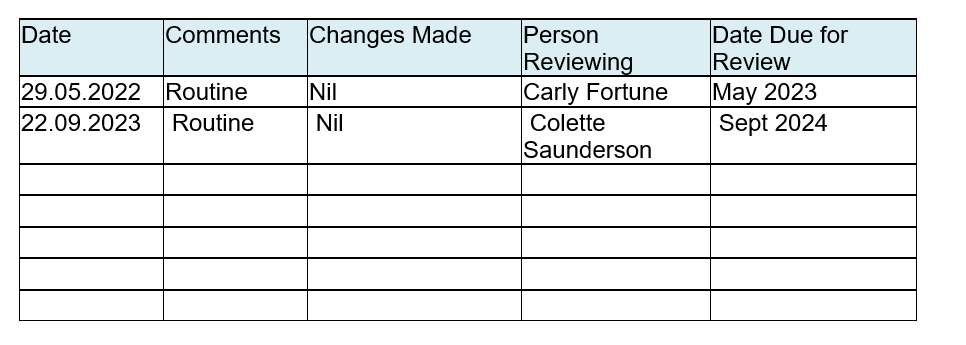
Date Reviewed: May 2021
Person responsible for updating this policy: Carly Fortune
Next Review Date: May 2022