Scope
Policy Statement
The Policy
- Toilets and Washing Facilities
- Rest Facilities
- Smoking
- Working Time
- Night Workers
- New and Expectant Mothers
- First Aid
Related Policies
Related Guidance
Training Statement
Policy Statement
As an organization, we recognize the importance of staff welfare, within the domiciliary office environment, and the wider implications for all users of such premises.
The Policy
Toilets and Washing Facilities
We provide suitable toilet and washing facilities, rest facilities in relation to a sleep-in duty and changing facilities for people at work, meeting the Health and Safety Executive (HSE) requirements.
| Number of people at work | Number of toilets | Number of washbasins |
|---|---|---|
| 1-6 | 1 | 1 |
| 6-25 | 2 | 2 |
| 26-50 | 3 | 3 |
Sufficient toilets and washing facilities with lockable doors are provided for the maximum number of people likely to be at work at any time. The toilet area is clean, well-lit, adequately ventilated and supplied with hot and cold water, soap, and drying facilities. Provision is made for the disposing of sanitary dressings where women use toilets.
Men and women have separate facilities. There are no disabled toilets available in the business premises.
Rest Facilities
Rest facilities with seating are provided for the employee to take breaks with facilities to obtain drinking water and prepare hot water is available for their use. There is a place for employees who eat their meals at work and they are provided with clean surfaces on which food can be placed. For those working out of hours or in locations where hot food cannot be obtained, facilities for storing and heating their food are provided. Staff are welcome to use the communal kitchen to store and prepare any snacks or meals, a fridge, kettle and microwave are available, tea and coffee etc. are provided and staff are welcome to use the small room for breaks.
Smoking
This organisation does allow smoking either in or outside the premises therefore smokers must leave the grounds. Staff are reminded that dropping any smoking related litter in the UK carries a fixed notice penalty of £150 and non-payment can result in a £2500 fine and possible criminal conviction.
Working Time
Although the Working Time Regulations do not come under Health and Safety at Work Act, it is helpful for employers to be aware of the duties so we have included them here for information. The basic rights and protections that the Working Time Regulations provide for workers are:
- A limit of an average of 48 hours a week which a worker can be required to work (though workers can choose to work more if they want to).
- For night workers, an average of 8 hours of work in every 24 hours (calculated over the appropriate reference period).
- The right for night workers to receive free health assessments.
- The right to 11 hours consecutive rest a day.
- The right to a day off each week.
- The right to rest break if the working day is longer than six hours.
- The right to 5.6 weeks paid annual leave pro rata to days worked.
A worker is someone who has a contract of employment, or someone who is paid a regular salary or wage and works for an organisation, business, or individual. Workers can agree to work longer than the 48-hour limit. An agreement must be in writing and signed by the worker. This is generally referred to as an opt-out. It can be for a specified period or an indefinite period. You as an employer cannot force a worker to sign an opt-out. Workers cannot be dismissed or subjected to disciplining for refusing to sign an opt-out.
Young workers have special rights under the Working Time Regulations. The rights of young workers (those over the minimum school leaving age but under 18) and those under the minimum school age on approved work experience schemes differ in the following ways:
- A limit of eight hours working time a day and 40 hours a week (unless there are special circumstances).
- Not to work either between 10 pm and 6 am or between 11 pm and 7 am (except in certain circumstances).
- 12 hours rest between each working day.
- Two days weekly rest and a 30-minute in-work rest break when working longer than four and half hours.
Night Workers
As an organisation, it is our responsibility to ensure workers are fit for night work. We, therefore, offer a free health assessment to anyone who is about to start working nights and to all night workers regularly, as appropriate. A risk assessment will be completed and if appropriate advise staff to contact GP. A night worker cannot opt out of the average of 8 hours in 24 hours, although there are exceptions in healthcare where there is a need for continuity of service. Where a night worker’s work involves a special hazard or heavy physical or mental strain, there is an absolute limit of 8 hours on their working time each 24 hour period, which is not an average.
HSE and local authorities are responsible for the enforcement of the maximum weekly working time limit, night work limits and health assessments for night work. Rest and leave entitlements are enforced through employment tribunals. Records are kept by this organisation to show compliance with the above regulations.
New and Expectant Mothers
As an organisation we:
- Initially assess risk to all employees, taking into account any specific risk to females of childbearing age who could become pregnant, and control these risks so far as reasonably practicable.
- If an employee notifies us in writing that she is pregnant, has given birth in the previous six months, or is breastfeeding, we carry out further risk assessments as required.
- We have a duty to regularly monitor and review any assessment made to take into account possible risks that may occur at different stages of the pregnancy.
- We request a certificate from the employee’s GP or midwife confirming their pregnancy. If an employee fails to produce a certificate within a reasonable amount of time, we are under no obligation to implement special control measures.
If any risks are identified that go beyond the level of risk found outside the workplace, we take the following actions to remove the pregnant employee from those risks:
Action 1: temporarily adjust her working conditions and/or hours of work, unless it is not reasonable to do so, or would not avoid the risk.
Action 2: offer her suitable alternative work (at the same rate of pay) if available, or, if that is not feasible.
Action 3: suspend her from work on paid leave for as long as necessary to protect her health and safety and that of her child.
As an organisation, we seek employment law advice concerning these areas from ACAS North East. Newcastle Civic Centre. Barrass Bridge. Newcastle upon Tyne. NE1 8QH.
First Aid
We provide adequate and appropriate equipment, facilities, and personnel to ensure that employees receive immediate attention if they are injured or taken ill at work.
Carly Fortune RGN. Registered Manager. First aider.
Hazel Feeley RGN. First aider.
Colette Saunderson. First aider.
First Aid box located in nurses office on bookshelf and in kitchen.
All staff carry small first aid kits.
Related Policies
Accidents, Incidents and Emergencies Reporting (RIDDOR)
Equal Opportunities
First Aid
Health and Safety
Maternity, Paternity, Adoption and Shared Leave
Smoking
Staff Sleep-In
Stress Management
Related Guidance
ACAS Working Time:
www.acas.org.uk
GOV.UK Night Working Hours:
https://www.gov.uk/night-working-hours
HSE First Aiders:
www.hse.gov.uk
HSE New and Expectant Mums:
www.hse.gov.uk
ACAS Pregnancy and Maternity Discrimination:
www.acas.org.uk
Training Statement
All staff, during induction, are made aware of the organisation’s policies and procedures, all of which are used for training updates. All policies and procedures are reviewed and amended where necessary, and staff are made aware of any changes. Observations are undertaken to check skills and competencies. Various methods of training are used, including one to one, online, workbook, group meetings, and individual supervisions. External courses are sourced as required.
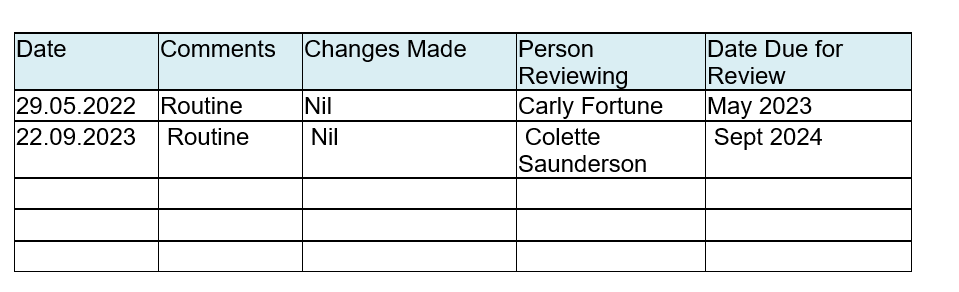
Date Reviewed: May 2021
Person responsible for updating this policy: Carly Fortune
Next Review Date: May 2022