Scope
- Policy Statement
- Staff Smoking
- Guidance
- The Policy
- Violations
- Disputes
- Support to Stop Smoking
- Addendum to Smoking Policy
- o Statement
- o Questions of Safety
- o Risks to Others from E-Cigarette Vapour
Related Policies
Related Guidance
Training Statement
Policy Statement
Domiciliary care company smoking policies should be based on the anti-smoking laws that are now in force under the Health Act 2006 and the Smoke-Free (Premises and Enforcement) Regulations 2006. However, they are in an unusual position regarding the legislation. The non-smoking laws apply to public places and workplaces. This means that no employee can smoke inside an organisation’s or service premises. But domiciliary service work also takes place in the private homes of people who receive their services and which are not workplaces as defined in the legislation; there is no ban on smoking in private places.
Company smoking policies need to be reviewed as a result of the Health Act 2006, which bans smoking in all enclosed public places. The law requires enclosed public places (including workplaces) to be smoke-free. Vehicles used for business purposes are also affected by the law. Outdoor areas are not covered by the legislation. The legislation affects most public premises with only a few exemptions, mainly on humanitarian grounds. Any smoking by service users should not present a hazard.
Staff Smoking
Many employers have provided a designated smoking area for staff to use during their breaks. The Health Act 2006 now makes such provision illegal. All staff, volunteers and contractors are now covered by the legislation and are banned from smoking in the workplace. Employers are empowered to apply a total ban on smoking inside and/or outside their premises. Managers should agree on a suitable policy with their staff, including designated staff representatives, wherever possible.
All staff should be made aware that the breach of smoking guidelines could lead to disciplinary action. Sanctions against smokers breaking the rules should be included in a misconduct clause in either a contract of employment or a disciplinary policy.
If confronted with a member of staff who fails to comply with the ban on smoking on company premises, managers should:
- Tell them that the company would be breaking the law if it allowed them to smoke; that they are breaking the law by smoking in smoke-free premises or vehicle; and that both parties could be fined.
- Remind them that the law is to protect employees and the public from the harmful effects of their second-hand smoke.
- Remind them of the organisation’s policy and of the likely repercussions of continued refusal to comply with the policy.
- If necessary, put into practice the disciplinary procedure for non-compliance with the organisation’s smoke-free policy.
- Keep a record of when and where incidents took place, the names of those involved and the outcome.
Staff who continue to refuse to comply should be given a written warning and, where indicated in the disciplinary procedure, may have their employment terminated.
In addition to the premises, smoking is banned in all vehicles run by the company and in any vehicles used by employees as part of their work. This is particularly relevant when a private vehicle is being used to convey passengers.
Smoke-free vehicles will need to display a no-smoking sign in each compartment of the vehicle in which people can be carried. This must show the international no-smoking symbol in dimensions of at least 70mm in diameter.
Guidance
The principles of any policy in light of the current legislation and general trends are as follows:
- Non-smoking should be regarded as the norm.
- Priority should be given to the needs of non-smokers who do not wish to inhale tobacco smoke.
- Special provision that complies with anti-smoking legislation is made for any smoking permitted.
- Smokers should be segregated from non-smokers.
- The wishes and views of staff, concerning exposure to second-hand smoke from service users who do smoke, should be carefully considered.
Domiciliary care managers must take reasonable steps to make all staff and service users aware of their policies, which have been made to comply with anti-smoking legislation.
This domiciliary care company smoking policy applies to all its employees. The policy has been developed after consultation with the people who use our services, stakeholders and company staff.
As employers, we recognise our duty to provide an environment that enables residents to follow their preferred lifestyles and for staff to meet their contractual duties.
When a service user is a smoker, included with the health and safety risk assessment of the service user’s property is a home fire safety checklist. Any identified risks are discussed with the service user and their family and where necessary they are encouraged to have a visit from their local Fire and Rescue home fire safety officer. If, however, no action is taken and the danger of fire continues a safeguarding alert would be sent to the local authority and the service may be withdrawn if it is deemed an unsafe working environment.
We respect people’s rights to smoke, particularly in and around their own homes. At the same time, we must safeguard the health of everyone who does not smoke and who does not want to inhale smoke from others. Our policy is to ensure that no one is subject to second-hand smoke against their wishes.
The company is committed to promoting the health and safety of its employees and all the people who use its services. There is now a substantial body of research that links smoking to a variety of serious medical conditions, and evidence is increasingly suggesting that these health risks apply equally to passive smokers. There is also evidence that links smoking to increased fire risks.
The Policy
There must be no smoking in respect of the following:
- Smoking is forbidden on all premises owned by the company.
- Company employees are not allowed to smoke in either the homes or outside areas of the people who use its services.
- Staff must not smoke in their cars on any occasion that they transport service users, or in transport provided by or paid for by the company.
- The company does not provide any breaks or respite for its employees to smoke at any time or in any place. Employees must bear this in mind when travelling between calls.
- This organisation ensures that its premises are clearly marked with no-smoking signs that comply with regulations issued under the Health Act 2006.
- Policies in respect of smoking in the service user’s homes.
- The company undertakes to identify the smoking/non-smoking behaviour and habits of all service users and co-residents when contracting to provide a service to them. It has also prepared an information leaflet that it issues to prospective service users and everyone who uses the service.
- This organisation also undertakes to obtain the views of its staff on whether they are prepared to inhale second-hand smoke in service users’ own homes and to accommodate their wishes, e.g. not to be exposed in any way to second-hand smoke wherever possible.
- The organisation might need to carry out a risk assessment and management plan to reduce the health risks to staff to an acceptable level.
- It then forms an agreement with the service user and co-residents who smoke, which is written into the care plan and contract. This states the conditions under which the service will be provided, based on the information they have about the service user’s smoking behaviour and habits and the health risks involved.
- All service users and co-residents who smoke will be asked not to do so during a visit from a member of the company’s staff. Where there is a risk of staff inhaling considerable amounts of second-hand smoke, service users might also be asked to put aside a room that is smoke-free for the visit.
Violations
The company’s management treats breaches of the rules as serious matters of discipline and is dealt with accordingly. Staff violations of the policy are subject to normal disciplinary procedures and sanctions. The company instructs all new staff to read the policy on smoking as part of their induction and refers them to the no-smoking clause in their contract of employment, or employee handbook.
Disputes
Staff members who find that they are exposed to unacceptable amounts of second-hand smoke during a visit should discuss the matter with the service user and co-resident regarding the organisation’s policy. If the situation does not improve, the care worker should report the matter to their line manager to investigate and discuss with the service user. All such disputes should be recorded.
Support for Stopping Smoking
Service users who wish to stop smoking can be referred to their GP or put in touch with the local NHS smoking cessation service. Staff wishing to give up smoking should discuss the matter with their supervisor or care home manager; they may be able to refer the staff member to occupational health support or smoking cessation service.
ADDENDUM TO SMOKING POLICY
Use of Electronic Cigarettes (‘e-cigarettes’ or ‘e-cigs’)
Statement
E-cigarettes are licensed and regulated as a medicine so that the government can be sure if they are effective and safe for use.
Questions of Safety
E-cigarettes do not contain any tobacco, only nicotine; though highly addictive, nicotine is much less dangerous. For this reason, smoking e-cigarettes (known as ‘vaping’) is generally regarded as a safer alternative to smoking for those unable or unwilling to stop using nicotine. However, a 2016 Study published in Environmental Science & Technology identified harmful emissions in the vapour, including carcinogens and irritants, though at much lower levels than conventional cigarettes.
Risks to Others from E-Cigarette Vapour
Research to date has not shown vapour to be harmful since it largely consists of water.
This organisation is aware of the current guidance around the use of e-cigarettes. At present, e-cigarettes are deemed on balance to present very little risk to passive smokers whilst benefiting those who are trying to stop.
Related Policies
Code of Conduct for Workers
Health and Safety
Meeting Needs
Risk Assessment
Related Guidance
Gov.UK Fire Safety in the Home:
https://www.gov.uk/government/uploads/system/uploads/attachment_data/file/564803/Fire-Safety-in-the-Home.pdf
NICE Quality Standard [QS92, July 2015: Smoking: Harm Reduction (offers advice and tools to help a person stop smoking):
https://www.nice.org.uk/guidance/qs92
E-Cigarettes Tobacco Products Directive 2014/14/EU (TPD):
https://www.gov.uk/guidance/e-cigarettes-regulations-for-consumer-products
Smoke-free (Private Vehicles) Regulations 2015 came into force on 1 October 2015. All staff who use company vehicles must co-operate with these regulations. Staff are also reminded that the use of their own vehicle is included in this particular set of regulations. These are fixed penalty notices payable for any offence.
http://www.legislation.gov.uk/ukdsi/2015/9780111126004/pdfs/ukdsiem_9780111126004_en.pdf
Want 2 Stop:
http://www.want2stop.info/
Gov.UK Smoking at Work: The Law
https://www.gov.uk/smoking-at-work-the-law
NHS Quit Smoking
https://www.nhs.uk/live-well/quit-smoking/10-self-help-tips-to-stop-smoking/
Training Statement
All staff, during induction, are made aware of the organisation’s policies and procedures, all of which are used for training updates. All policies and procedures are reviewed and amended where necessary, and staff are made aware of any changes. Observations are undertaken to check skills and competencies. Various methods of training are used, including one to one, online, workbook, group meetings, and individual supervisions. External courses are sourced as required.
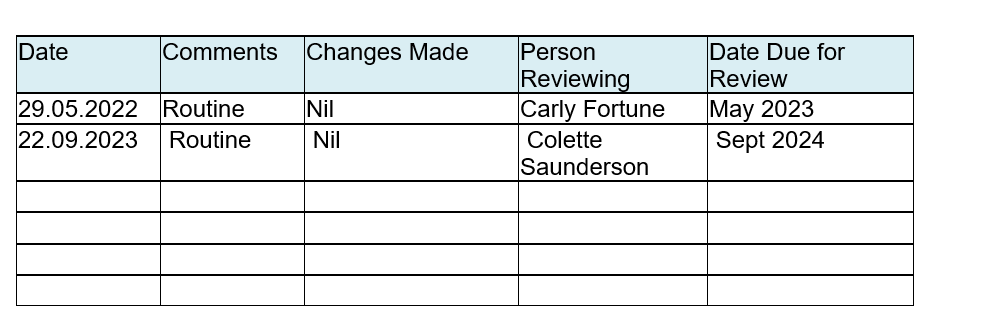
Date Reviewed: May 2021
Person responsible for updating this policy: Carly Fortune
Next Review Date: May 2022