Scope
Policy Statement
The Policy
- Volunteer Agreement
- Sickness Absence Reporting Procedure
- Evidence of Incapacity: Medical Evidence
- Unauthorised Absence
- Sickness Pay
- Keeping in Contact During Sickness Absence
- Medical Examinations
- Return to Work Interviews
- Sickness Absence Meetings
- o Right to be Accompanied at Meetings
- o Stage 1 First Sickness Absence Meeting
- o Stage 2 Further Absence Sickness Meeting
- o Stage 3 Final Sickness Absence Meeting
- o Appeals
Related Policies
Related Guidance
Training Statement
Policy Statement
The policy statement acknowledges that there are various forms of sickness absence and that each case needs to be treated on its facts. The need to report sickness absence, investigate the cause of absence and identify means of assisting return to work is explained. Sickness absence can vary from short intermittent periods of ill-health to a continuous period of long-term absence and have several different causes (for example, injuries, recurring conditions, or a serious illness requiring lengthy treatment).
This organisation works to ensure that the reasons for sickness absence are understood in each case and investigated where necessary. In addition, where needed and reasonably practicable, measures will be taken to assist those who have been absent because of sickness to return to work. This policy does not form part of any employee’s contract of employment and it may be amended at any time. We may also vary the procedures set out in this policy, including any time limits, as appropriate in any case. This policy covers all employees at all levels and grades, including senior managers, officers, directors, employees, trainees, home care workers, part-time and fixed-term employees and agency staff. As an organisation, we are aware that sickness absence may result from a disability. At each stage of the sickness absence meetings procedure, particular consideration will be given to whether there are reasonable adjustments that could be made to the requirements of a job or other aspects of working arrangements that will provide support at work and/or assist a return to work. If an employee considers that they are affected by a disability or any medical condition which affects their ability to undertake their work, they should inform their line manager.
The Policy
This policy is intended to set out the values, principles and guidance underpinning this organisation’s approach to sickness absence.
Sickness Absence Reporting Procedure
If taken ill or injured while at work the employee should report or be taken to their line manager and if necessary be given permission to leave work.
A member of the direct care staff who cannot attend work, because they are ill or injured, should telephone their line manager as soon as possible or at least two hours before their shift is to begin. If the employee is an office-based member of staff, they should contact their line manager as early as possible and no later than 30 minutes after the time when they are normally expected to start work.
The following details should be provided:
- The nature of the illness or injury.
- The expected length of time of absence from work.
- Contact details.
- Any outstanding or urgent work that requires attention.
Managers should ensure that:
- Any sickness absence that is notified to them is recorded on Carefree
- Arrangements are made, where necessary, to cover work and to inform colleagues and clients, while maintaining confidentiality.
- Employees should expect to be contacted during their absence by their line manager, who will want to enquire after their health and be advised, if possible, as to their expected return date.
Evidence of Incapacity: Medical Evidence
For sickness absence of up to seven calendar days, a self-certification form which is available from their line manager must be completed.
For absence of more than a week, a certificate from the employee’s doctor (a Statement of Fitness for Work) stating that they are not fit for work and the reason(s) why must be obtained. This should be forwarded to the line manager as soon as possible. If the absence continues, further medical certificates must be provided to cover the whole period of absence.
If the doctor provides a certificate stating that the employee “may be fit for work” the line manager must be informed immediately. The organisation will discuss any additional measures that may be needed to facilitate the return to work of the employee, taking account of any doctor’s advice. This may take place at a return to work interview. If measures cannot be taken, the employee will remain on sick leave and the organisation will set a date to review the situation.
Where the organisation is concerned about the reason for absence, or frequent short-term absence, they may require a medical certificate for each absence regardless of duration. In such circumstances, any costs incurred in obtaining such medical certificates for absences of a week or less will be covered by the organisation, on the production of a doctor’s invoice.
Unauthorised Absence
Cases of unauthorised absence will be dealt with under our disciplinary procedure.
Absence that has not been notified according to the sickness absence reporting procedure will be treated as an unauthorised absence.
If an employee does not report for work and has not telephoned their line manager to explain the reason for their absence, their line manager will try to contact them, by telephone and in writing if necessary. This must not be treated as a substitute for reporting sickness absence.
Sickness Pay
If the employee is absent from work, they are entitled to Statutory Sick Pay (SSP), provided the relevant requirements are satisfied. Qualifying days for SSP purposes are Day 1 to Day 3.
Keeping in Contact During Sickness Absence
If an employee is absent on sick leave, they will be contacted from time to time by their line manager to discuss their wellbeing, expected length of continued absence from work and any work that requires attention. Such contact is intended to provide reassurance and will be kept to a reasonable minimum.
If an employee has any concerns while absent on sick leave, whether about the reason for their absence or their ability to return to work, they are free to contact their line manager between 9 am and 5 pm.
Medical Examinations
We may, at any time in operating this policy, ask an employee’s consent to a medical examination by a doctor nominated by us at our expense. The employee will be asked for consent that any report produced in connection with any such examination may be disclosed to us and that we may discuss the contents of the report with our advisers and the relevant doctor.
Return to Work Interviews
If an employee has been absent on sick leave for any period, including a series of one day and part-day absences, we will arrange for them to have a return-to-work interview with their line manager or their delegated representative.
A return-to-work interview enables us to confirm the details of an employee’s absence. It also allows them to raise any concerns or questions they may have, and to bring any relevant matters to our attention.
Where their doctor has provided a certificate stating that they ‘may be fit for work’, we will usually hold a return-to-work interview to discuss any additional measures that may be needed to facilitate the return to work, taking account of the doctor’s advice.
Sickness Absence Meetings
We may apply this procedure whenever we consider it necessary, including, for example if the employee:
- Has been absent due to illness on three occasions.
- Has discussed matters at a return to work interview that requires investigation.
- Has been absent for more than 10 days irrespective of it being the first period of sickness absence.
Unless it is impractical to do so, we will give seven days written notice of the date, time and place of a sickness absence meeting. We will put any concerns about the sickness absence and the basis for those concerns in writing or otherwise advise why the meeting is being called. A reasonable opportunity for the employee to consider this information before a meeting will be provided.
The meeting will be conducted by their line manager, wherever possible, and may be attended by any other member of the management staff. The employee may bring a companion with them to the meeting.
The employee must take all reasonable steps to attend a meeting. Failure to do so without good reason may be treated as misconduct. If either the employee or their companion is unable to attend at the time specified, they should immediately inform their line manager who will seek to agree on an alternative time.
A meeting may be adjourned if the line manager is awaiting receipt of information, needs to gather any further information or give consideration to matters discussed at a previous meeting. A reasonable opportunity to consider any new information obtained before the meeting is reconvened will be given.
Confirmation of any decision made at a meeting, the reasons for it, and of the right of appeal will be given in writing within five days of a sickness absence meeting (unless this time scale is not practicable, in which case it will be provided as soon as is practicable).
If at any time, the line manager considers that the employee has taken or is taking a sickness absence when they are not unwell, they may refer matters to be dealt with under the organisation’s disciplinary procedure.
Right to be Accompanied at Meetings
The employee may bring a companion to any meeting or appeal meeting under this procedure.
The companion may be either a trade union representative or a fellow employee. Their identity must be confirmed to the manager conducting the meeting in good time before it takes place.
Stage 1 First Sickness Absence Meeting
The purposes of a first sickness absence meeting may include:
- Discussing the reasons for absence.
- Where the employee is on long-term sickness absence, determining how long the absence is likely to last.
- Where the employee has been absent on several occasions, determining the likelihood of further absences.
- Considering whether medical advice is required.
- Considering what, if any, measures might improve the health and/or attendance of the employee.
- Agreeing to a way forward, the action that will be taken and a time-scale for review and/or a further meeting under the sickness absence procedure.
Stage 2 Further Absence Sickness Meeting
Depending on the matters discussed at the first stage of the sickness absence procedure, a further meeting or meetings may be necessary. Arrangements for the meeting will follow the procedure already set out.
The purposes of further meeting(s) may include:
- Discussing the reasons for and impact of the ongoing absence(s).
- Where the employee is on long-term sickness absence, discussing how long the absence is likely to last.
- Where there has been absence on several occasions, discussing the likelihood of further absences.
- If it has not been obtained, considering whether medical advice is required. If it has been obtained, considering the advice that has been given and whether further advice is required.
- Considering the employees’ ability to return to/remain in their job in view both of their capabilities and the organisations business needs and any adjustments that can reasonably be made to the job to enable a return to work.
- Considering possible redeployment opportunities and whether any adjustments can reasonably be made to assist in redeploying.
- Where the employee can return from long-term sick leave, whether to their job or a redeployed job if possible, agreeing on a return to work programme.
- If it is considered that they are unlikely to be able to return to work from long-term absence, whether there are any benefits for which they should be considered.
- Agreeing on a way forward, the action that will be taken and a time-scale for review and/or a further meeting(s). This may, depending on steps we have already taken, including warnings that they are at risk of dismissal.
Stage 3 Final Sickness Absence Meeting
Where the employee has been warned that they are at risk of dismissal, their line manager may invite them to a meeting under the third stage of the sickness absence procedure. Arrangements for this meeting will follow the procedure set out above on the arrangements for and right to be accompanied at sickness absence meetings.
The purposes of the meeting will be:
- To review the meetings that have taken place and matters discussed.
- Where the employee remains on long-term sickness absence, to consider whether there have been any changes since the last meeting under stage two of the procedure; either as regards their possible return to work or opportunities for return or redeployment.
- To consider any further matters that the employee may wish to raise.
- To consider whether there is a reasonable likelihood of the employee returning to work or achieving the desired level of attendance in a reasonable time.
- To consider the possible termination of their employment.
- Termination will normally be with full notice or payment in lieu of notice.
Appeals
The employee may appeal against the outcome of any stage of this procedure and a companion may accompany them to an appeal meeting as stated above.
An appeal should be made in writing, stating the full grounds of appeal, to their line manager within five days of days of the date on which the decision was sent to them.
Unless it is not practicable, written notice of an appeal meeting will be given within one week of the meeting. In cases of dismissal, the appeal will be held as soon as possible. Any new matters raised in an appeal may delay an appeal meeting if further investigation is required.
The employee will be provided with written details of any new information that comes to light before an appeal meeting and also be given a reasonable opportunity to consider this information before the meeting.
Where practicable, an appeal meeting will be conducted by a manager senior to the individual who conducted the sickness absence meeting.
Depending on the grounds of appeal, an appeal meeting may be a complete rehearing of the matter or a review of the original decision. Following an appeal, the original decision may be confirmed, revoked or replaced with a different decision. The final decision will be confirmed in writing, if possible within five days of the appeal meeting. There will be no further right of appeal. The date that any dismissal takes effect will not be delayed pending the outcome of an appeal. However, if the appeal is successful, the decision to dismiss will be revoked with no loss of continuity or pay.
Related Policies
Appraisal
Code of Conduct for Workers
Disciplinary
Equal Opportunities
Supervision
Related Guidance
ACAS Managing attendance and employee turnover:
http://www.acas.org.uk/
Training Statement
All staff, during induction, are made aware of the organisation’s policies and procedures, all of which are used for training updates. All policies and procedures are reviewed and amended where necessary, and staff are made aware of any changes. Observations are undertaken to check skills and competencies. Various methods of training are used, including one to one, online, workbook, group meetings, and individual supervisions. External courses are sourced as required.
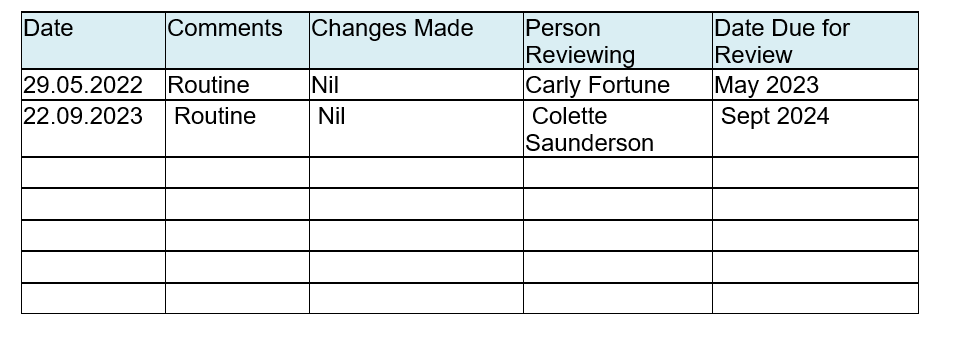
Date Reviewed: May 2021
Person responsible for updating this policy: Carly Fortune
Next Review Date: May 2022