Scope
Policy Statement
The Policy
- Preventing Missing person Incidents
- Missing Person Procedure
- Line Manager’s Responsibilities on Receiving a Missing Person’s Report
- Procedure to Follow After a Missing Persons Incident
Related Policies
Related Guidance
Training Statement
Policy Statement
Very often, service users for whom this organization provides care are frail, infirm or limited in their mobility. Some may also be confused or easily disoriented and therefore become easily lost. For these reasons, a service user going missing from their home, while under the care of a staff member from this organization, should lead to concern for service user’s safety and be considered as a potential emergency.
The Policy
The policy intends to set out the process for staff in the event of a missing person situation.
Preventing Missing person Incidents
Staff from this organisation should always remain vigilant, and be aware of exactly where service users are at any given time. service users who are prone to wandering, or who may be at risk of getting lost owing to their mental state, should have this identified during risk assessment and a suitable entry made in their plan of care. Such service users should be kept under observation as appropriate to the level of risk identified.
Situations, where a missing person’s report should be made, include the following:
- Where a service user has not returned from, or has got lost during, an arranged activity or walk.
- Where a service user cannot be found in their house or garden, and when no prior arrangements have been made to explain their absence.
If it becomes clear that a service user may be missing, all members of staff in the organisation must work as a team and follow a clearly defined procedure.
Missing Person Procedure
Immediately upon suspicion that a service user may be missing, staff at the service user’s home or place of care should:
- Initiate an immediate search of the building and its immediate surroundings.
- Contact relatives, friends, neighbours or other obvious persons/places where the service user visits or has been known to visit in the past.
- Telephone the service user’s mobile phone.
If the service user cannot be found during the initial search, then the member of staff should immediately raise the alarm by informing their line manager at the office by phone. They should pass on all relevant information, such as the full details of the service user (it is very important to correctly identify the service user) and full details of the incident, including when and where the service user was last seen, by whom, and what the service user was wearing. The member of staff should then remain outside the service user’s home or place of care in their vehicles in case the service user returns, if the staff member is a non driver then the office make arrangements a driver to attend.
Line Manager’s Responsibilities on Receiving a Missing Person’s Report
Upon receiving a missing person’s report, the line manager should do the following:
- Make immediate efforts to contact the service user’s relatives or carers, if not already done, to inform them of the situation, to gather information and to get advice.
- Contact the police and give full details about the service user, including when and where they were last seen, by whom, what they were wearing and any special risk factors involved. Advise the police that you have a current photograph that can be sent electronically if available a copy of a completed Herbert protocol.
- Contact telephone numbers should be given and the line manager should remain in contact to coordinate the organisation’s response and to maintain communications.
- Co-operate fully with any police search.
Where the police are involved, the organisation’s registered owners should be informed as soon as possible, as should members of the missing service user’s family if they have not already been contacted. Families should be requested to telephone the office or police if the service user contacts them, and relatives should be kept informed at each stage of the search.
The line manager should, at the earliest opportunity, fill out an incident form and ensure that a full note of events has been made in the service user’s notes by the member of staff at the service user’s home. Log all the people and organisations who have been contacted. Times of actions and decisions should be noted as accurately as possible. After the incident, staff involved should be asked to check the incident form for accuracy and sign and date it.
Once the service user has been found, it is essential that all the parties who were advised of the emergency are contacted again and informed that the search has been concluded, including the member of staff at the service user’s home and the police (see log).
At all stages the line manager should be sensitive to the needs of members of staff involved, who might be upset by the incident, and should provide or arrange any support required; this may include bringing in extra staff to help or sending someone to “sit” with the staff involved, and checking that staff are well before they go home.
If at any stage the duty manager is unsure of what to do then the registered owner should be contacted immediately for advice.
Procedure to Follow After a Missing Persons Incident
Upon conclusion of a missing person incident the organization should;
- Undertake a full enquiry and investigate the incident thoroughly. Investigations should be led by the organisation’s registered owner who will also be responsible for implementing any improvements that are indicated.
- Staff can learn from these investigations and implement any changes to improve the service.
- Update the service users risk assessments as required and their care/ support plan.
- Regulation 20: Duty of Candour requires that a Care Quality Commission notification should be completed and submitted online, and if a breach of the harm threshold has occurred due process must be followed.
Related Policies
Adult Safeguarding
Duty of Candour
Notifications
Related Guidance
Missing from Care A Multi-Agency Approach: http://library.college.police.uk/docs/APPREF/Protecting-Vulnerable-Missing-Adults-Framework-FINAL.pdf
SCIE: Adult safeguarding practice questions
https://www.scie.org.uk
Training Statement
All staff, during induction, are made aware of the organisation’s policies and procedures, all of which are used for training updates. All policies and procedures are reviewed and amended where necessary, and staff are made aware of any changes. Observations are undertaken to check skills and competencies. Various methods of training are used, including one to one, online, workbook, group meetings, and individual supervisions. External courses are sourced as required.
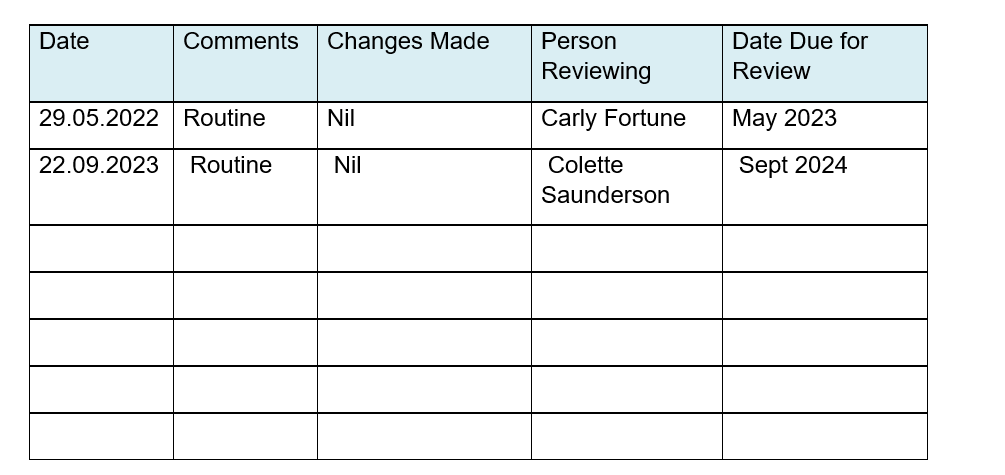
Date Reviewed: May 2021
Person responsible for updating this policy: Carly Fortune
Next Review Date: May 2022