Scope
- Policy Statement
- The Policy
- Using a Piece of Equipment for the First Time
- Infection Prevention Control
- Reporting Incidents
- Damaged or Broken Equipment
- The Role of the Medicines and Healthcare Products Regulatory Agency
- Related Policies
- Related Guidance
- Training Statement
Policy Statement
Medical devices play a key role in health and social care, vital for diagnosis, therapy, monitoring, rehabilitation and care. As an organisation, we ensure our staff are competent to use the medical devices required by the service users and work with suppliers and other health care professionals to provide safe and effective care for service users in the community.
The Policy
Using a Piece of Equipment for the First Time
When a member of staff is required to use a piece of equipment for the first time they must ensure:
- That any service or maintenance checks are up to date and recorded.
- That the information they need is in the service users care plan and the manufacturer’s instructions for use are available.
- That they are trained and competent to use the specific piece of equipment.
- That they know how the device works and functions correctly.
- That they inform the service user and or representative that a new device is being used and answer any questions.
Infection Prevention Control
- Wash hands before using any medical device.
- Gloves and aprons must be worn during any procedure.
- Non-single use devices must be cleaned after use, following makers instructions
- All single-use devices must be disposed of in the correct waste container or sharps box.
- Remove gloves and wash hands.
Reporting Incidents
This could include:
- Inadequate instructions for use.
- Inadequate training received.
- Inadequate maintenance records.
- Inadequate or inappropriate repairs or replacement parts.
- Unsuitable storage or use conditions.
- The device not working adequately enough to fulfil the task.
- The device used inappropriately.
- Device unfit for use due to damage.
Any incident relating to a medical device that prevents the member of staff from carrying out a safe procedure must be immediately reported to management initially by phone and then recorded on the appropriate form.
Damaged or Broken Equipment
When a member of staff finds a piece of equipment or medical device damaged or broken it must, where possible, be put to one side and labelled ‘Do Not Use’.
Damaged or broken equipment should be reported immediately to management/on-call who will contact the relevant company.
If emergency replacement equipment is required, management/on-call should be contacted who will arrange a replacement urgently with the relevant organisation.
In an emergency contact office and follow the contingency plan. If someone has been seriously injured as a result of damaged or faulty equipment, contact emergency services.
In addition to incident reports being completed an online RIDDOR report will be sent as required and notification to Care Quality Commission (CQC) as soon as possible and within 24 hours
The Role of the Medicines and Healthcare Products Regulatory Agency
The Medicines and Healthcare Products Regulatory Agency (MHRA) has the responsibility for ensuring that medicines and medical devices are effective and acceptably safe. You should be aware that MHRA asks healthcare workers, carers, patients and members of the public to report adverse incidents involving medical devices. When a medical device is suspected or known to be faulty, MHRA will work with manufacturers and distributors on the most appropriate and timely action to take.
Related Policies
Accidents, Incidents and Emergencies Reporting (RIDDOR)
Adult Safeguarding
Control of Substances Hazardous to Health COSHH
Health and Safety
Infection Control
Medication
Moving and Handling
Notifications
Record Keeping
Related Guidance
MRHA:
https://www.gov.uk/report-problem-medicine-medical-device
HSE Equipment Safety in Health and Social Care:
http://www.hse.gov.uk/healthservices/equipment-safety.htm
Training Statement
All staff receive practical training on the use of individual pieces of equipment and have regular competency observations. This is carried out in-house or by relevant health professionals or manufacturers of the equipment. All staff, during induction, are made aware of the organisation’s policies and procedures, all of which are used for training updates. All policies and procedures are reviewed and amended where necessary, and staff are made aware of any changes. Observations are undertaken to check skills and competencies. Various methods of training are used, including one to one, online, workbook, group meetings, and individual supervisions. External courses are sourced as required.
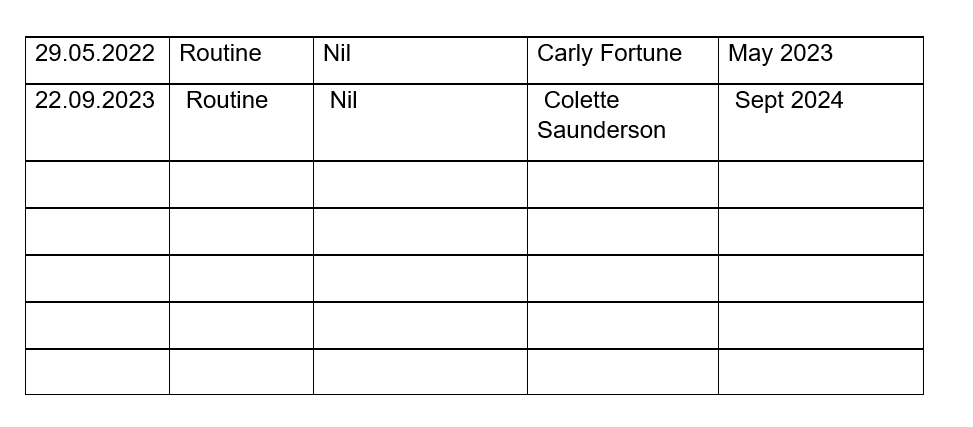
Date Reviewed: May 2021
Person responsible for updating this policy: Carly Fortune
Next Review Date: May 2022