Scope
- Policy Statement
- The Policy
- Formal Homeworking
- Sporadic Homeworking
- Practical Considerations
- Homeworking Checks
- Procedure
- Related Policies
- Related Guidance
- Training Statement
- Homeworking Checklist
- Employer’s Guide: Stay on the Right Side of the Law
Policy Statement
Homeworking is a generic term for a type of flexible working, agreed between the organisation and certain, specified job roles. It is usually available to job roles where report writing, written recording, or completion of data is a requirement of the role. It is important to note that data protection principles apply even when working at home is undertaken, whether it is a regular or sporadic part of the role.
What is homeworking?
It is usually applied to office-based roles where the following applies:
- Some staff work almost entirely at home apart from regular or occasional meetings/duties at the office.
- Some staff split their time between working at home a few days a week, or month, with the rest of their work being office based or with service-users.
- Some staff work from home occasionally, or, in some task-related capacity e.g. writing reports, completing tenders, appraisals, confidential personnel matters such as disciplinary investigations, particularly those involving multi-agency partners.
The Policy
Formal Homeworking
This is where it is recognised that to gain the most from the job role, homeworking should form part of the contractual agreement between the organisation and the post holder, e.g. a police officer’s job would be a suitable post for homeworking in a formal arrangement, simply in recognition that an open plan office environment could make it difficult to read, research, collate and write within such an office, but would not be necessary for a dedicated office space used by them or a group of police officers.
Sporadic Homeworking
This is where specific tasks in a job role are recognised as being suited to homeworking, e.g. annual appraisals, confidential reports etc. could all be considered, on an as and when basis for flexible home working.
Practical Considerations
Availability
Organisation and staff should understand the working arrangements, e.g. hours of work, contact arrangements, deadlines for work to be completed.
On-site Attendance
In the formal arrangements, clarity of when they attend on-site office activities should be agreed upon and recorded within the written contractual agreement.
Equipment and Resources
This should be agreed and any equipment should be maintained by the organisation. Supplies such as stationary, print cartridges etc. should be available. Where equipment e.g. laptop, is owned by staff who are happy to use it, remuneration should be claimed or supplies such as paper, ink cartridges etc. should be available from the office.
Homeworking Checks
Is the job suitable? The organisation should assess whether to encourage, allow or refuse a request for staff to work from home, how much or how little of the work is suitable for homeworking. Many roles might be, but not all are. A key requirement is that the role should be performed just as well away from the office base by someone working on their own.
Is the Jobholder Suited to Homeworking? To be successful, staff working from home need attributes to cope with working from home, on their own, and, in reality, probably with less supervision. Homeworkers ideally need to be:
- Happy to spend long periods on their own
- Self-disciplined and motivated
- A resilient personality who doesn’t let setbacks get them down
- Confident working without supervision
- Able to separate work from home life
- In addition, for home working to work, the following should be discussed and agreed upon:
- Keeping business information confidential
- Health and safety considerations
- Is planning permission required from the mortgage or landlord?
Procedure
When a request or consideration of homeworking for a particular post is being discussed all of the above points should be discussed, agreed upon, and recorded on an individual or identified post basis. The written agreement should be held on file and a review date set to pick up any issues or problems early. The checklist should assist in ensuring all points are covered. It is important for staff to understand this is not a permanent flexible working request, which is subject to separate considerations.
Related Policies
Confidentiality
Cyber Security
Data Protection Legislative Framework (GDPR)
Health and Safety
Social Media and Public Relations
Related Guidance
HSE Homeworking:
http://www.hse.gov.uk/
Training Statement
The manager responsible for decision making in this area of activity will be kept updated with any changes which would impact the organisation’s consideration regarding homeworking. All staff, during induction, are made aware of the organisation’s policies and procedures, all of which are used for training updates. All policies and procedures are reviewed and amended where necessary, and staff are made aware of any changes. Observations are undertaken to check skills and competencies. Various methods of training are used, including one to one, online, workbook, group meetings, and individual supervisions. External courses are sourced as required.
Homeworking Checklist
Introduction
Opening statement: The employer should set out its commitment to flexibility to meet both its employees’ needs. It should also make clear that while homeworking is categorised as a type of flexible working, employees should not assume that other aspects of flexible working (such as amended hours) are automatically part of a homeworking arrangement.
Define homeworking: The employer should set out types of homeworking that the policy will cover and whether home or the employer’s business premises will be the main place of work. For example, the types might include:
- Home as the main place of work
- Flexible home working with time splits between home and the office
- Mobile working with a base at home to travel to the employer’s different premises and customers
- The office is the main place of work with working from home occasionally
The employer should
- Ask an employee to apply in writing.
- Outline the process to be followed and factors to be considered in assessing their application (preferably linking to a flexible working policy).
- Say who will make the decision.
- State the grounds on which the employee can appeal if their request is refused.
Business Case
Is the Role Suitable for Homeworking? The employer should set the factors for assessing whether the role can be done just as well away from the business base by someone working on their own.
Is the Jobholder Eligible? The employer should set out who will be eligible. For example:
- Those requesting it as a reasonable adjustment
- Those making a flexible working request
- Those who have completed a certain length of service or satisfactorily completed their training and achieved satisfaction in their last annual performance review
Is the Jobholder Suitable? Personal qualities required are likely to be:
- Self-motivation and discipline
- Ability to work without direct supervision
- Ability to complete work to deadline
Is the Home Suitable? Homeworkers need a safe and reasonable space, security and privacy in which to work, and for office-type tasks an internet connection able to support work systems.
Will Homeworking Be Beneficial? An arrangement should meet business needs and the employee’s needs so it is favourable for both
Other important practicalities
Health and Safety Risk Assessments. The employer has a duty of care to its employees and should carry out a risk assessment before homeworking can be approved. It should set out what will happen if the risk assessment identifies concerns including who will make and pay for changes to bring the home up to standard, and what timescale will be allowed. It should also set out what will happen if concerns are not addressed and reserve the right to refuse a homeworking application.
Setting Up the Employee to Work from Home The employer should set out:
- What the company will provide, e.g. furniture, phone, phone line, broadband, printer, fire extinguisher, paper.
- What the employee is expected to provide, e.g. heating and lighting.
- Who will pay for any installation and other necessary costs, and, if required and agreed, how costs can be claimed back.
- Who the equipment belongs to, who is responsible for maintaining/moving it and how this will be done and whether it can, or cannot, be used for personal matters by the homeworker or their family.
Running costs and expenses. The employer should state whether it will contribute towards costs in working from home – for example, heating and lighting – and expenses. If so, it should state how much, what can be claimed and how, and what is taxable.
Taxation. The employer should set out the implications of homeworking on tax. To find out more see HMRC’s guidance.
Mortgage, lease and insurance issues. The employee should tell their mortgage provider or landlord and home insurer of their intention to work from home. They should check that there isn’t anything preventing them from working at home – for example, in their mortgage agreement, lease or insurance. The employee should obtain from their home insurer confirmation of cover should work equipment cause damage and for a claim from a third party. The employer should say if it will pay the extra if the employee’s premium rises as a result. Work property and a claim by a third party should be covered by the employer’s insurance policy.
The Employer’s Access to the Employee’s Home. The employer should say how frequently and in what circumstances it would require access to the home. For example
- Initial set-up.
- Maintenance of equipment.
- Health and safety assessment.
- Electrical equipment testing.
- One-to-one meetings with managers/colleagues/clients.
If the Employee Moves Home? The employer should set out what will happen if a homeworker wants to move house
Managing the Homeworker
Employee Performance. The employer should set out how employees who work from home will be managed consistently with office staff and given the same opportunities for training, development and promotion. It should also refer to its policies relating to:
- Health and Safety.
- Monitoring and performance.
- Team working.
- Communication.
- Training, development and support.
The employer should ensure that employees who work from home are clear about their hours and the core hours when they should be at work.
The Employee’s Attendance at the Main Office/Base. The employer should set out how frequently, for how long, where and for what reason the employee’s attendance at the organisation’s premises will be required.
Security Including Information. he employer should set out how staff working from home should store and transmit documents and information
Employer’s Guide: Stay on the Right Side of the Law
Health and Safety
Health and safety for homeworkers can be a little different than for employees at an employer’s base, but it should be remembered that employers have a duty of care for all their employees, and the requirements of all the health and safety legislation apply to homeworkers.
It is the employer’s responsibility to carry out a risk assessment to check whether the proposed home workplace’s ventilation, temperature, lighting, space, chair, desk and computer, or any other kind of work station, and floor are suitable for the tasks the homeworker will be asked to do.
The employer is responsible for the equipment it supplies, but it is the responsibility of the employee to rectify any flaws in the home highlighted by the assessment. The employer should not allow homeworking until any problem has been resolved.
Once the home workplace is passed as safe, it is the responsibility of the homeworker to keep it that way and take reasonable care of their health and safety. However, they should tell the employer if any precautions turn out to be inadequate.
Employers should be aware that inspectors from the Health and Safety Executive (HSE) have the right to visit homeworkers in the home, but it is very unlikely to happen.
The HSE has guidance on low-risk homeworkers, such as in office-type roles. It also has advice regarding high-risk homeworkers such as where heights, violence and hazardous materials can be dangerous.
The HSE also offers advice on how to carry out a risk assessment and examples of assessments.
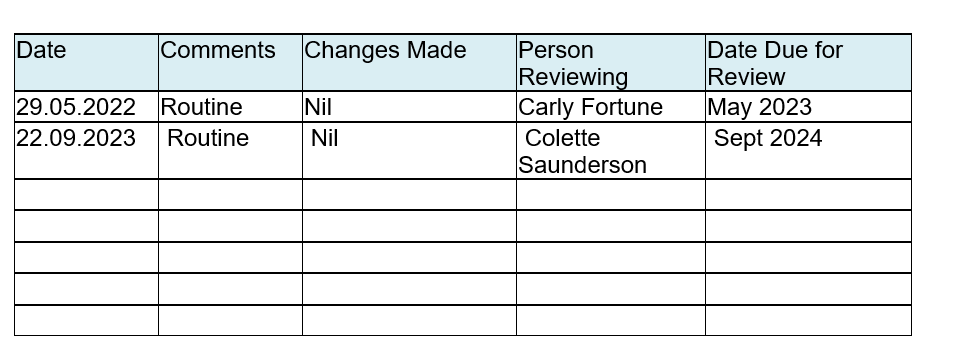
Date Reviewed: May 2021
Person responsible for updating this policy: Carly Fortune
Next Review Date: May 2022