Scope
- Policy Statement
- The Policy
- Uniform
- Staff Delivering Personal Care to Service Users
- Staff Delivering Support to Service Users
- Volunteers, Contractors, or Self-employed
- Managers and Office Staff
- General
- Related Policies
- Related Guidance
- Training Statement
Policy Statement
This policy sets out the requirements of all categories of staff within this organisation concerning the wearing of uniforms and standards of dress.
The definition of staff is all workers, staff, and management. This includes volunteers, agency workers, and self-employed contractors, who must be appropriately dressed at all times
Students undertaking placements are expected to adhere to the policies agreed between this organisation and the relevant education provider.
The Policy
- This policy clarifies the requirements for all staff concerning standards of dress. Health and safety demands are such that clarity needs to be in place to ensure that our duty of care to staff and service users is understood and respected.
- The standard of dress must support infection prevention and control requirements of the Care Quality Commission (CQC) Regulations.
- The standards of dress are such that it enhances the safety and wellbeing of staff and presents a professional image to our multi-agency partners, service users and the local community
This organisation, whilst implementing a dress code, nonetheless recognises the diversity of cultures, religions, and disabilities of its employees, where necessary, and will take a sensitive approach when this affects dress or uniform requirements.
The Dress Code Policy is designed to guide managers and employees on the application of standards of dress and appearance. The policy sets out acceptable and unacceptable standards of dress. Staff should use commonsense in adhering to the principles underpinning the policy.
All employees are supplied with this organisation’s identity/security badge, which must be worn and be visible during working hours or when representing this organisation in an official capacity.
All staff are required to comply with the principles of the Dress Code Policy. Failure to adhere to this organisation’s standards of dress may constitute misconduct and may result in formal disciplinary proceedings.
Employees are responsible for following the standards of uniform/dress laid down in this policy and should understand how this policy relates to their working environment, health and safety, infection control, particular role and duties, and contact with others during their employment.
Managers are responsible for ensuring that the Dress Code Policy is adhered to at all times by the workers they manage, and must be mindful of the requirements regarding contractors, agency staff, and volunteers, etc.
Uniform
Staff Delivering Personal Care to Service Users
All staff delivering personal care to service users must:
- Wear the uniform provided by this organisation in a clean and presentable fashion.
- o Teal coloured scrub style tunic
- o Smart black trousers. However, plain black jogging bottom or jeans may be worn but only at the discretion of management
- o Appropriate footwear – flat with toes covered.
- Use appropriate PPE, e.g. gloves, aprons, bacterial gel, masks.
Staff Delivering Support to Service Users
All staff delivering support to service users must:
- Wear the uniform provided by this organisation in a clean and presentable fashion.
- o Teal coloured scrub style tunic
- o Smart black trousers. However, plain black jogging bottom or jeans may be worn but only at the discretion of management
- o Appropriate footwear – flat with toes covered.
- This includes ancillary staff, and agency workers employed by this organisation
Volunteers, Contractors, or Self-employed
All volunteers, contractors, or self-employed must:
Be appropriately dressed for the task for which they are engaged to do. Common sense should be the guiding principle, but at all times the following applies:
- All tops must cover the upper torso completely; vests are not acceptable.
- Shorts, if worn must be knee-length, tailored for both men and women.
- Shoes must be appropriate for the task; open-toed sandals should not be worn.
- All appropriate clothing must be safe and acceptable in the workplace, e.g. mini/maxi type clothing is not acceptable.
- Clothing should be clean, serviceable, and fit for the task.
Managers and Office Staff
The dress code for this group of staff is not definitive but must be clean, servicable, fit for the task and not offensive
General
- The uniforms issued must not be altered or added to by the individual. If changes are required, they must be discussed with your line manager.
- Maternity uniforms will be provided for staff where necessary.
- This organisation does not provide a laundry service, but staff must ensure that uniforms are laundered following guidance provided on the uniform. In the event of any confusion, staff should contact the ICP lead in the organisation for guidance on appropriate washing temperatures.
- All staff leaving this organisation who have been provided with a uniform must return their uniform to their line manager.
- Nail varnish, false nails, and false eyelashes are not permitted. Nails should be sufficiently short to ensure safe service user contact and good hand hygiene.
- Visible tattoos are to be discouraged and, where present, should not be offensive to others. Where they are deemed to be offensive, they should be appropriately covered.
- Jewellery must be kept to a minimum for staff delivering care or support. A plain/wedding ring and one pair of discreet stud earrings are permitted. Wristwatches must not be worn when providing care or support.
- Facial/visible body piercing can be a health and safety issue and must be removed before coming on duty.
- If staff have piercings for religious or cultural reasons, these must be covered and must not present a quantifiable health and safety risk, or an infection prevention and control risk.
- Hair should be neat and tidy at all times and long hair should be tied back for a care and support environment. Headscarves worn for religious purposes are permitted in most areas; however, they are excluded in any clinical areas where they could present a health and safety and cross-infection hazard. Beards should be short and neatly trimmed unless this reflects the individual’s religion, in which case it should be tidy. Beards should be covered with a hood when undertaking aseptic procedures.
It is a requirement that all staff of this organisation adhere to the golden rules, set out below, for information sharing in all instances of information exchange between all multi-agency partner external contacts. Any request for such information will only be shared when all the golden rules are met.
Related Policies
Code of Conduct for Workers
Personal Protective Equipment
Related Guidance
Skills for Care Code of Conduct: https://www.skillsforcare.org.uk/Leadership-management/managing-people/code-of-conduct/Code-of-Conduct.aspx
Employee Handbook
The Health and Social Care Act 2008 Code of Practice on the Prevention and Control of Infections and Related Guidance: https://assets.publishing.service.gov.uk/government/uploads/system/uploads/attachment_data/file/449049/Code_of_practice_280715_acc.pdf
Dress Code and Sex Discrimination: What you Need to Know: https://www.gov.uk/government/publications/dress-codes-and-sex-discrimination-what-you-need-to-know
Training Statement
All staff, during induction, are made aware of the organisation’s policies and procedures, all of which are used for training updates. All policies and procedures are reviewed and amended where necessary, and staff are made aware of any changes. Observations are undertaken to check skills and competencies. Various methods of training are used, including one to one, online, workbook, group meetings, and individual supervisions. External courses are sourced as required.
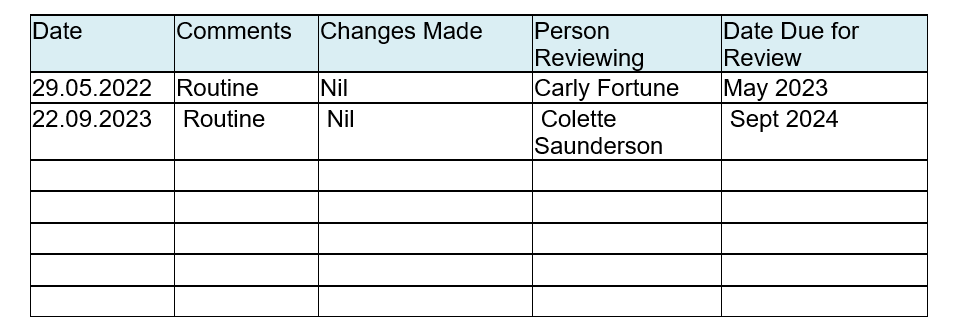
Date Reviewed: May 2021
Person responsible for updating this policy: Carly Fortune
Next Review Date: May 2022