Scope
Policy Statement
- The Policy
- Arrangements
- Information Sharing
- Emergency Admission to Hospital Procedure
- Multi-Agency Working
- Consent
- Transfer Methods
Related Policies
Related Guidance
Training Statement
Policy Statement
This organisation is committed to a service that prioritises the service user. As a private provider, there are some business activities that, from a commercial perspective, cannot be shared. In the interests of openness and clarity, we detail our co-operation mode di emploi and when we would share and exchange information.
During a Pandemic such as Coronavirus, we follow the government guidance on working with other professionals and co-operating with other providers. This guidance and any local restriction tiers are monitored regularly and the necessary procedures are in place to work safely with other providers.
The Policy
This policy aims to ensure that, where there is more than one provider of care and support, all multi-agency partners are aware of our commitment to our service users and to assist where possible in a smooth transfer of information between multi-agency partners and other providers.
Arrangements
From time to time, situations occur where it is important to share information to play our part in making a valid contribution to a seamless service for the service user.
So that care planning information is shared concerning the admission, transfer, or discharge of service users, and to facilitate any emergency procedure coordination with the minimum of distress and anxiety, we will co-operate fully with our multi-agency partners in the exchange of information.
Where multi-agency working is involved, we will ascertain the lead responsibility for the coordination of the care. We are aware of our Civil Emergency Team in our local authority (LA), and have emergency and contingency plans in place.
We are aware of data protection legislation, and our confidentiality policies and procedures include sharing on a need to know basis. The shared information will be appropriate, measured, transferred securely, up to date, and relevant.
Information is reviewed and updated using the review system.
If information relates to a safeguarding allegation or disclosure is in the public interest, senior management advice is sought before any information is released to ensure the release is following relevant legislation and guidance.
Information Sharing
We will ensure that any exchange of information will adhere to data protection requirements and will include the following as a minimum:
- Name.
- Gender.
- Date of birth.
- Address.
- Unique identification number or reference number.
- Emergency contact details.
- Any person who acts as a representative, advocate, or who holds a lasting power of attorney (LPA) or equivalent, with contact details, where available.
- Records of care, treatment, and support provided up to the date of transfer.
- Assessed needs.
- Known preferences and any relevant diverse needs.
- Previous medical history that is relevant to the service user’s present needs and any relevant GP contact details.
- Any infection that needs to be managed.
- Any medicines the service user needs to take.
- Any allergies the service user has.
- Reason for transferring to the new service.
- Any advanced decision and any assessed risk of suicide or homicide or harm to self and others.
The above information should ensure that there are no interruptions to the continuity of care, treatment, and support of the service user.
Emergency Admission to Hospital Procedure
- When a member of staff decides that the health of the service user has deteriorated or when the service user has had an accident, they must ring the office or the on-call supervisor. The office or on-call supervisor will decide to call the GP or paramedics. The member of staff will be asked to stay with the service user until the paramedics or GP arrive.
- If a decision is made by a GP or the paramedic team that the service user needs emergency hospital admission the member of staff present must re-contact the office immediately.
- The office will contact the next of kin to either accompany the service user or meet them at the hospital.
- The member of staff will be required to give relevant verbal information to the paramedic team concerning the history of events, known allergies, medical conditions, medication and given a copy of the ‘Transfer between Services Passport’ document. Any further requests for information must be directed to the office.
- Any Care Quality Commission (CQC) notifications should be completed by the manager and sent online to CQC.
- If relevant, any RIDDOR notifications must be made.
- If relevant, any accident forms should be completed and signed.
- Before the service user returns home, this organisation will ensure that it can continue to meet the needs of the service user through liaising with the hospital and family and carrying out a revised needs assessment.
Multi-Agency Working
Where multi-agency working is involved, the organisation will ascertain the lead responsibility for the coordination of the care. We are aware of our Civil Emergency Team in our LA. We have emergency and contingency plans in place pertaining to the Civil Contingencies Act 2004 or Coronavirus Act 2020.
This organisation is conscious of data protection legislation; our confidentiality policies and procedures include sharing on a need to know basis. The shared information will be appropriate, measured, transferred securely, up to date, and relevant.
Information is reviewed and updated using the review system.
If information relates to a safeguarding allegation or disclosure is in the public interest, senior management advice is sought before any information is released to ensure the release is following relevant legislation and guidance. All staff are made aware of acceptable methods of transferring information and how important it is that the information is relevant, factually correct, and omits subjective opinions, and can be shared online following data protection legislation and any other relevant guidance.
Consent
Where consent cannot be obtained, it is recorded, including the reasons and the necessity of sharing the information. Where possible individuals are aware of the information that is being transferred and are provided with a copy when requested.
Transfer Methods
If the information cannot accompany the individual, it must be transferred securely and safely afterwards. Where there is particularly sensitive personal information, a courier service will be used to ensure confidentiality.
Related Policies
Confidentiality
Consent
Cyber Security
Data Protection Legislative Framework (GDPR)
Medication
Notifications
Related Guidance
Overview of adult social care guidance on coronavirus https://www.gov.uk/guidance/overview-of-adult-social-care-guidance-on-coronavirus-covid-19#history
NICE Guidelines [NG 22], November 2015: Older people with social care needs and multiple long-term conditions:
https://www.nice.org.uk/guidance/ng22
NICE Quality Standard QS 136, May 2020: Transition between inpatient hospital settings and community or care home settings for adults with social care needs
https://www.nice.org.uk/guidance/qs136
NICE Guidelines [NG43], February 2016: Transition from children to adults’ services for young people using health or social care services
https://www.nice.org.uk/guidance/ng43
Hospital Passport Template: Dementia:
https://dementia.livebetterwith.com/
Going to hospital:
https://www.nhs.uk/conditions/learning-disabilities/going-into-hospital/
Coronavirus Act 2020:
http://www.legislation.gov.uk/ukpga/2020/7/pdfs/ukpga_20200007_en.pdf
Training Statement
All staff, during induction, are made aware of the organisation’s policies and procedures, all of which are used for training updates. All policies and procedures are reviewed and amended where necessary, and staff are made aware of any changes. Observations are undertaken to check skills and competencies. Various methods of training are used, including one to one, online, workbook, group meetings, and individual supervisions. External courses are sourced as required.
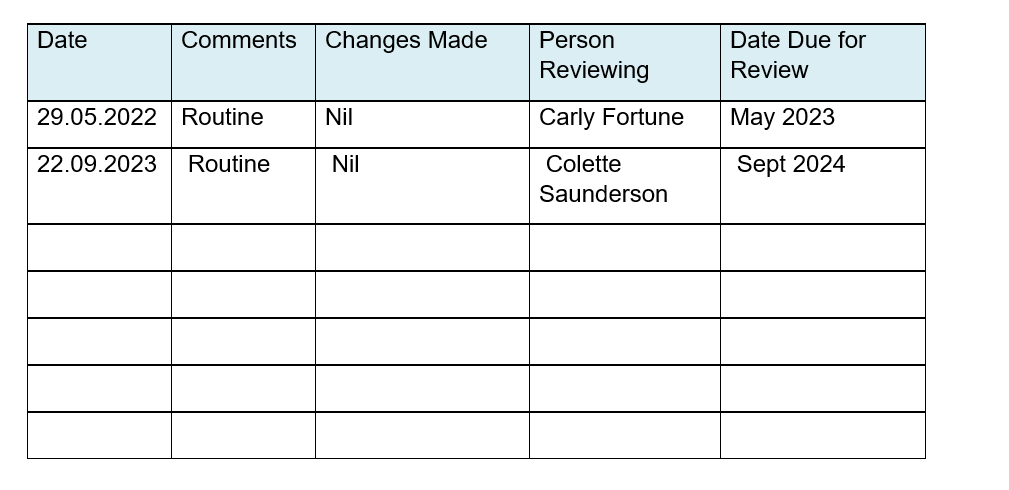
Date Reviewed: May 2021
Person responsible for updating this policy: Carly Fortune
Next Review Date: May 2022