Scope
- Policy Statement
- The Policy
Care Needs Assessment
- Ethical Considerations
- Future Developments
- Related Policies
- Related Guidance
Training Statement
Policy Statement
Assistive technology is a generic term, covering a multitude of devices or systems that assist individuals with certain tasks. Generally, this technology is grouped according to its purpose.
Supportive technologies help the individual with tasks and include things such as walking aids, walking frames, bath aids, etc. Preventative technologies manage risk and raise alarms such as numeric entry pad keys, automatic lighting, etc. Telecare is used to describe sensors or detectors, such as flood, gas, falls, etc. that sends a signal via a base unit connected to a telephone line (tele), to a carer, community alarm, or monitoring service, which can call for assistance (care) when it is needed.
Examples of assistive technology are numerous but can include:
- Electronic location devices, using GPS technology that can locate people who have become lost or disorientated.
- Temperature, smoke, and carbon monoxide detectors, which can be standalone devices or can be linked to several other devices that enable gas or electricity supplies to be cut off automatically or power-operated windows to be opened.
- Memo minders can help people who have difficulty remembering to carry out tasks.
- Medication dispensers can help people who have difficulty remembering to take their medication.
This list is not exhaustive but serves to demonstrate the possibilities now available through assistive technology, which, like all technology, is improving all the time in its range and use of products.
The Policy
Care Needs Assessment
It is important that, from the outset, any use of assistive technology is discussed with the service user, their family, or representative, and consent for such use is recorded as part of the assessment process and incorporated into their care plan. As a forward-looking company, we are always happy to explore any avenue that enhances and maintains the independence of our service users and contributes to their wellbeing. It is important that assistive technology is personalised to the needs of the service user and offers the overall best value contribution so that any investment of time and resources keeps costs to a minimum.
Ethical Considerations
As with many new ideas, assistive technology has the potential to benefit people, but it can also be misused or have unintended effects. It can offer greater independence and free up carers time, but some aspects can compromise people’s privacy, autonomy, and wellbeing. Particular attention should be paid to the care planning process, including assessment, installation, consent, and training in its use so that the beneficial effects of the technology are realised.
Current assistive technology in use.
CareFree – All care schedules and rostering will be via this system, the carer portal enables staff to access system specific information including rotas, wages, live call notes and connection back to the office. The client portal or relative access to specific information regarding service delivery, invoices, call notes and contact logs. Roadrunner is an electronic call monitoring system which links in real time with Carefree allowing carers to log in and out using NFC technology, collation of information such as call notes, task completion, medication and any concerns are all options which can be used.
The Act ensures information is available in two ways.
1. Public authorities are obliged to publish certain information about their activities.
2. Members of the public are entitled to request information from public authorities.
Future Developments
There is no doubt that assistive technology is an evolving element of health and social care but, as in most things, the benefits need to be evaluated as the technology develops. It is important to remember that the technology is part of a range of remedies that, if used and utilised appropriately, can benefit individuals and businesses to enhance lives and contribute to lower costs of service delivery over time.
Related Policies
Accessible Information and Communication
Assessment of Need and Eligibility
Data Protection Legislative Framework (GDPR)
Consent
Record Keeping
Related Guidance
SCIE Dementia-friendly environment: Assistive technology:
https://www.scie.org.uk/
Alzheimer’s Society: What is assistive technology:
https://www.alzheimers.org.uk/
Gov.UK Guidance: Assistive technology for disabled and older people: research and development work:
https://www.gov.uk/government/publications/assistive-technology-for-disabled-and-older-people-research-and-development-work
Training Statement
Any assistive technology service that is introduced will be in place after staff and, where appropriate, service users are fully conversant with its use and updated where and when required. All staff, during induction, are made aware of the organisation’s policies and procedures, all of which are used for training updates. All policies and procedures are reviewed and amended where necessary, and staff are made aware of any changes. Observations are undertaken to check skills and competencies. Various methods of training are used, including one to one, online, workbook, group meetings, and individual supervisions. External courses are sourced as required.
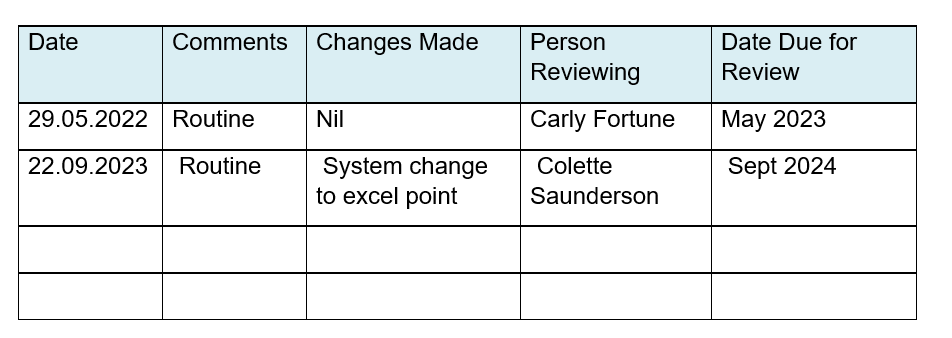
Date Reviewed: May 2021
Person responsible for updating this policy: Carly Fortune
Next Review Date: May 2022