
Scope
Policy Statement
The Policy
Principles
- Informal Resolution of Grievances
- Grievance Hearings
- Appeals
- Remedies
- Representation
- Anonymity
Related Policies
Related Guidance
Training Statement
- Addendum Staff Guide
Policy Statement
This organization is aware that, from time to time, staff may have an issue about their colleagues or management of the organization. Staff must be aware that any grievance brought to this organization be listened to and acted upon by the management. This document outlines the policy of this organization concerning staff grievances
The Policy
Principles
A grievance is any complaint made by a member of staff under specified procedures that alerts the management to, instigates the investigation of, and if necessary, redresses the unreasonable actions of the organization, a manager or another member of staff.
The Employment Rights Act 1996 imposes an obligation on employers to specify, in their written statements of terms and conditions of employment, the person or position to whom employees can apply for the redress of any grievance relating to their employment and how such applications should be made.
This organization aims to ensure that its staff feel fully involved in the work of the organization and form a cohesive team in the interests of providing high-quality services. We, therefore, wish to identify and deal with any grievances that a member of staff has with the work of colleagues or managers. We believe that this will foster communication between staff and managers; ensure that staff concerns are recognized and dealt with promptly; help managers to identify areas for improvement in the work of the organization, and give early warning of potential sources of more serious conflict.
Procedures relating to grievances, however, must be clearly distinguished from any action taken under the organization’s Disciplinary Policy and procedures, and an appeal against disciplinary decisions will not be treated as a grievance.
Informal Resolution of Grievances
If a member of staff has an issue with the behavior of a manager of another member of staff that makes them unhappy or uncomfortable then they should mention the matter to their immediate supervisor or line manager as soon as possible. If the issue relates to the supervisor or manager to whom the staff member would normally have reported, or if the relevant supervisor or line manager is not available, the staff member may approach any other manager.
The person presented with the issue should take steps to investigate and deal with it as quickly as possible to resolve the matter before it becomes more serious. They should report back to the employee as quickly as possible on either the action they have taken or the reasons for not taking action. In some cases, outside help such as an independent mediator can help resolve problems especially those involving working relationships.
If the staff member is not satisfied that their grievance is being acted on sufficiently seriously, or with the manager’s decision concerning the grievance, they have the right to request that their grievance should be dealt with by a more senior manager. In these circumstances, the original supervisor or manager should arrange for the staff member to explain their grievance at a higher level. The senior manager should then review whatever investigation and action have been taken already concerning the grievance; conduct any further investigation they consider necessary; and report back, to both the employee and the original supervisor or manager, as quickly as possible on either the action they have taken or the reasons for not taking action.
Grievance Hearings
If the staff member is still not satisfied after their grievance has been considered informally by two tiers of management, the matter should be referred to a very senior manager or a manager specifically designated to deal with personnel issues. This manager should then arrange as quickly as possible for a formal grievance hearing at which all of the relevant facts relating to the issue can be heard and considered. The person conducting the hearing should be a manager who has not been involved in the earlier investigations.
At the hearing, the staff member should be allowed to present their grievance and their reasons for continuing dissatisfaction. They may produce evidence and witnesses. Any staff or managers who are the subject of the grievance should then be allowed to state their point of view, producing evidence and witnesses as appropriate. Witnesses may be cross-examined on what they say and questioned by the manager conducting the hearing. After the matter has been thoroughly explained the manager conducting the hearing should consider and announce a decision.
Appeals
Any appeals relating to the grievance procedure will be held and conducted according to the relevant guidance issued by the Advisory, Conciliation and Arbitration Service (ACAS). ACAS produce guidance that is updated regularly and appropriate for employees and employers.
Remedies
If at any stage, informal or formal, of the handling of a grievance the staff member’s complaints are found to have substance then the relevant manager should consider what action should be taken to deal with the offending issue. This may take the form of a change of procedure, an apology from another staff member, or, in extreme cases, the initiation of disciplinary action against the staff member who caused the offence. If no action is to be taken the reasons should be explained as fully as possible to the person who initiated the grievance.
Representation
The Employment Relations Act 1999 gives all employees the right to be accompanied by a fellow employee or trade union representative during any stage of a grievance process. The organization undertakes to ensure that any employee assisting another employee under these circumstances will not be dismissed or victimized.
Anonymity
If the subject of the grievance is discrimination or harassment and the staff member making the complaints wishes to remain discreet, managers should make every effort to conduct their investigations in a way that protects the complainant.
Related Policies
Appraisal
Bullying and Harassment
Disciplinary
Supervision
Related Guidance
Staff Handbook
ACAS Disciplinary and grievance Procedures:
http://www.acas.org.uk
ACAS Code of practice on disciplinary and grievance procedures: http://www.acas.org.uk
ACAS Example Discipline and Grievance Procedures: https://www.acas.org.uk/example-discipline-and-grievance-procedures
Training Statement
All staff, during induction, are made aware of the organisation’s policies and procedures, all of which are used for training updates. All policies and procedures are reviewed and amended where necessary, and staff are made aware of any changes. Observations are undertaken to check skills and competencies. Various methods of training are used, including one to one, online, workbook, group meetings, and individual supervisions. External courses are sourced as required.
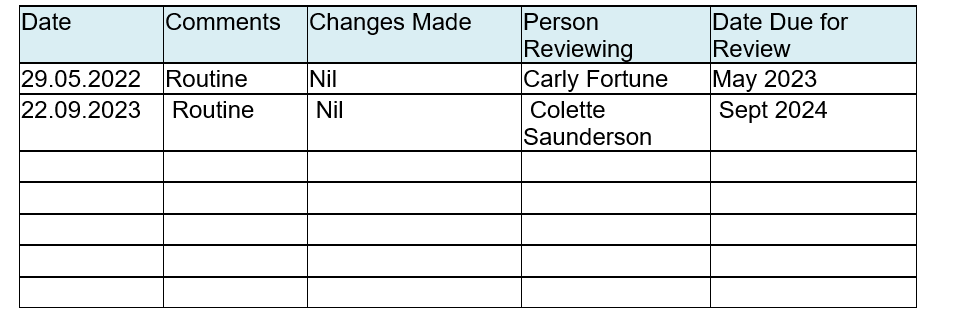
Date Reviewed: May 2021
Person responsible for updating this policy: Carly Fortune
Next Review Date: May 2022
Addendum: Staff Guide
Dealing with grievances informally
- If you have a grievance or complaint to do with your work or the people you work with you should, wherever possible, start by talking it over with your manager.
- You may be able to agree to a solution informally between you.
Formal grievance
- If the matter is serious and/or you wish to raise the matter formally you should set out the grievance in writing to your manager.
- You should stick to the facts and avoid language that is insulting or abusive.
- Where your grievance is against your manager and you feel unable to approach him or her you should talk to another manager or the owner.
Grievance hearing
- Your manager will call you to a meeting, normally within five days, to discuss your grievance.
- You have the right to be accompanied by a colleague or trade union representative at this meeting if you make a reasonable request.
- After the meeting, the manager will give you a decision in writing, normally within 24 hours.
- If it is necessary to gather further information before making a decision your manager will inform you of this and the likely timescale involved.
Appeal
- If you are unhappy with your manager’s decision and you wish to appeal you should let your manager know.
- You will be invited to an appeal meeting, normally within five days, and your appeal will be heard by a more senior manager (or the company owner).
- You have the right to be accompanied by a colleague or trade union representative at this meeting if you make a reasonable request.
- After the meeting, the manager (or owner) will give you a decision, normally within 24 hours.
- The manager’s (or owner’s) decision is final