Scope
- Policy Statement
- The Policy
- Definitions
- Care Practice
- Contacts
- Related Policies
- Related Guidance
- Training Statement
Policy Statement
This policy relates to people’s relationships and sexuality and focuses on caring for people who need support to express their sexuality, build and maintain relationships and have their needs met in an individualised way that respects their rights and protects their dignity and privacy.
The Policy
We have a duty to promote inclusive practices throughout our services including LGBT+. Our assessment of need includes a discussion of sexuality needs, explored in a sensitive and non-discriminatory way that protects people’s human rights. This includes exploring topics such as current and previous relationships, sexual orientation, and gender identity to ensure we understand individual needs and support people to feel confident and comfortable in their identity. Our approach to proactively supporting relationships begins with relaxed and open conversations, as well as the provision of information relevant to their individual needs. Discussions surrounding sexuality and relationships can be difficult for people so we will ask people what they are happy to talk with us about and tell them how we will ensure their confidentiality is maintained.
Definitions
- Sexuality encompasses gender identity, body image, sexual desires and experiences including preferences. People have needs relating to sexuality regardless of age, mental capacity, or personal history. It relates to sex, masturbation, sexuality, physical intimacy, romance, and physical attraction.
- Gender Identity or sexual orientation describes a person’s physical, romantic or emotional attraction to another person, e.g., straight, gay, lesbian, bisexual. It is their sense of identity as a man or woman, or someone who does not identify themselves as either. Sexual orientation is about who you are attracted to, gender identity is about your sense of identity, and self.
- LGBT + describes the lesbian, gay, bisexual and transgender community. The first three letters. (LGB) refers to sexual orientation, the T refers to gender identity. The + stands for other marginalised and minority sexuality or gender minorities such as omnigender, possessing all genders, and nonmonosexual, attracted to more than one gender.
- Sexual Disinhibition is where damage to specific parts of a brain can result in someone not being aware that their behaviour is unacceptable. This can lead to an individual becoming less sexually inhibited in their speech or behaviour and can increase or decrease sexual desire.
- Relationship and sex education (RSE) is a key way in which young people learn about sexuality, emotions and sexual health. Resources exist for service users with varying needs, e.g., easy read for Learning Disability, and are an excellent resource in supporting people to answer their questions.
Mental Capacity
- Where people can make a specific decision about relationships we will respect and support their decision.
- When an individual lacks the mental capacity to make a specific decision about a relationship it is important to remember that Best Interest Decisions, as defined within Section 27 of the Mental Capacity Act 2005 states “Nothing in the Act permits a decision on………. (b) consenting to have sexual relations.”
Care Practice
We believe that our care practice should respect the rights of people, be sensitive to their needs and wishes and provide the information and guidance that helps people remain safe and healthy and maintain or develop relationships.
Our care practice includes:
- Sexual orientation and gender identity are treated with respect.
- Our staff never forget that they are guests in a service user’s home and that providing a domiciliary care service should never interfere with service users’ rights to have visitors at any time and to entertain their visitors in private.
- For a person who has a marital, civil or sexual partner who resides with them or visits them, our service is provided in ways that respect their wish to be together in private.
- Service users are assured that while a worker is in their home there will be no interruption of privacy for any intimate or personal contacts or sexual activity.
- Service users can decide whom they see and do not see; if necessary and requested to do so, our staff provide support in these decisions and protection from any personal contacts who are unwelcome or abusive people.
- The opportunity is provided for service users to discuss matters relating to their sexual relationships and activities within the assessment and care planning process, always with due regard to the need to treat these issues with confidentiality and sensitivity.
- When intimate care is given, service users’ wishes as regards the gender of the worker are identified through assessment and incorporated in their care plan.
- We assist people who require access to advice or guidance, to ensure that any sexual activity they engage in is safe and pleasurable. This may include seeking specialist advice, for example from appropriate health or social care professional.
- An individual who due to disability requires assistance in fulfilling their sexual aspirations can discuss their needs with staff. We will, where possible as part of our care service, arrange for the appropriate help to be provided.
- Information about service users’ personal and sexual relationships and activities is treated confidentially and sensitively, passed only to those with a specific need to know.
- If an individual exhibits sexual disinhibition staff will take prompt and appropriate action. Staff will report to their supervisor who will consider actions that protect the individual, staff and others. This may include medical support where the behaviour is uncharacteristic, and/or risk assessments and plans that protect and support the individual, others and staff which are regularly reviewed.
- Staff should be aware of the potential for people to expose themselves to risk via their online activity and contact with others and staff should be vigilant to the risk of scams and the relationships and financial extortion through sexual blackmailing.
- All possible efforts are made to protect service users from any forms of sexual abuse. If an individual reports an incident including, sexual contact, sexual advance, assault or verbal or offensive gestures, we will take immediate action to safeguard the person and/or others, and report to appropriate agencies such as the police and local authority safeguarding team for advice and/or investigation. (please see safeguarding policy and procedures
- We will notify CQC in line with legal requirements.
- Where a resident or service user lacks the capacity to make a decision concerning relationships and has someone with health and welfare lasting power of attorney, they will be fully informed about the contents of this policy and provided with appropriate support and guidance if they seek it.
- Sexual relationships between staff and the individuals we support are expressly prohibited to protect both staff and service users in relation to the position of trust conflict.
- Where there are known risks or concerns, these will be risk assessed and mitigating plans agreed and acted on.
- If staff ever felt uncomfortable or concerned as a result of any sexual behaviour exhibited by or conversation with a service user, they should contact their manager for advice and support, and where relevant appropriate action would be taken.
Please see the following helpful guidance provided by CQC on relationships and sexuality in adult social care services.
Care Quality Commission Relationships and sexuality in adult social care services https://www.cqc.org.uk/sites/default/files/20190221-Relationships-and-sexuality-in-social-care-PUBLICATION.pdf which covers the following key guidance for staff:
- What is sexuality?
- What are sexual orientation and gender identity?
- What does the term LGBT+ mean?
- When should providers assess a person’s sexuality needs?
- How can providers help people develop their understanding of sexuality and relationships?
- Can a best interest assessment be made in relation to a person’s consent to sex?
- How can providers support people living with a physical disability?
- How can providers support people with accessing dating services?
- What is sexual disinhibition?
- How should providers support people who exhibit sexual disinhibition?
- How should providers respond to incidents?
- What if someone lacks the capacity to consent to sexual relations?
- How is someone’s capacity to consent to sexual relations assessed?
- Do care staff need specialist training?
- How are sexuality and relationships considered within the key lines of
- enquiry?
- Are there any specific questions relating to sexuality and relationships?
- How will this subject be reported in inspection reports?
- Appendix 1: Key lines of enquiry
- Appendix 2: Additional resources and references
Helpful Contacts for advice or guidance
Morpeth Relate. Northumberland NE61 1QD. Tel: 0191 2329109 / 01325 461500 northeast@relate.org.uk http://www.relatenortheast.org.uk/
- Relationship Counselling
One to One Centre. Thoroton Street, Blyth. NE24 1DX. Tel: 01670 515151. https://www.northumbria.nhs.uk/cdn-cgi/l/email-protection#9be8fee3f3fefaf7eff3e9fefdfee9e9faf7b5d5d7dfdbf5f4e9eff3eef6f9e9f2fab5f5f3e8b5eef0
- Confidential Sexual Health Service
- Sexually Transmitted Screening & Treatment
- All forms of contraceptive
Rape Crisis England & Wales (women and girls over 13 only) Tel: 0800 035 2794 http://www.gracenrc.org.uk/ email: enquiries@rctn.org.uk
Related Policies
Adult Safeguarding
Assessment of Need and Eligibility
Care and Support Planning
Code of Conduct for Workers
Equal Opportunities
Equality and Diversity
Mental Capacity Act 2005
Position of Trust
Related Guidance
Equality Act 2010
https://www.gov.uk/guidance/equality-act-2010-guidance
Protected Characteristics
https://www.legislation.gov.uk/ukpga/2010/15/section/4
Gov.UK LGBT Action Plan
https://www.gov.uk/government/publications/lgbt-action-plan-2018-improving-the-lives-of-lesbian-gay-bisexual-and-transgender-people
Section 27 Mental Capacity Act 2005
http://www.legislation.gov.uk/ukpga/2005/9/section/27
Stonewall
https://www.stonewall.org.uk/
Training Statement
All staff, during induction, are made aware of the organisation’s policies and procedures, all of which are used for training updates. All policies and procedures are reviewed and amended where necessary and staff are made aware of any changes. Observations are undertaken to check skills and competencies. Various methods of training are used including one to one, online, workbook, group meetings, individual supervisions and external courses are sourced as required.
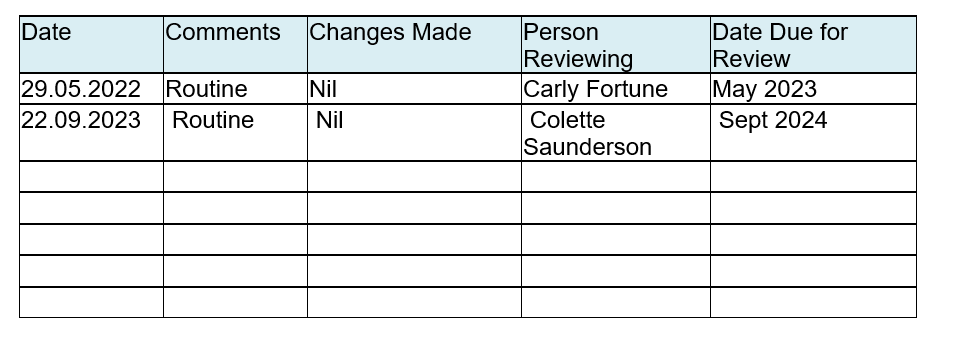
Date Reviewed: May 2021
Person responsible for updating this policy:
Next Review Date: May 2022