
Scope
- Policy Statement
- Schedule 6 list
- The Prevent Strategy
- Prevent Strategy Objectives
- The Policy
- The Statutory Guidance
- o Effective Leadership
- o Working in Partnership
- o Capabilities
- Risk-Based Approach
- Sharing Information
- Monitoring and Enforcement
- Central Support and Monitoring
- Inspection Regime in Individual Sectors
- Sector-Specific Guidance
- Channel
- o What is it?
- o Who does it work with?
- o The Channel Panel
- o Raising a Concern
- Related Policies
- Related Guidance
- Training Statement
Policy Statement
The Counter-Terrorism and Security Act 2015 became law in February 2015. It introduced a raft of measures, some of which are still being debated in parliament. The terrorism threat to the UK is considerable, and the government has acted to ensure that the intelligence agencies have the powers they need to keep us safe; it has issued statutory guidance to all relevant specified authorities.
Schedule 6 List
This list, which is regularly reviewed, includes all local authorities (LAs); anyone on the list is known as a ‘specified authority’. It also includes prison, health and social care, education, and police personnel at an identified level, for instance, a chief officer of police. The Act creates a general duty of ‘due regard’ on all ‘specified authorities’.
LAs must have due regard to local circumstances; give appropriate weight to the need to prevent people from being drawn into terrorism (see below), and consider all other factors relevant to how they carry out their usual functions.
The Prevent Strategy
This includes clarification of the Prevent Strategy first identified in 2011, which is a part of CONTEST, the government’s counter-terrorism strategy. CONTEST is made up of four workstreams, each comprising a set of objectives:
- Pursue: to stop terrorist attacks,
- Prevent: to stop people from becoming terrorists or supporting terrorism,
- Protect: to strengthen our protection against a terrorist attack,
- Prepare: to mitigate the impact of the terrorist attack.
This policy is intended to make staff aware of their role and responsibilities regarding the Prevent Strategy work, as required by the legislation.
Prevent Strategy Objectives
The Prevent Strategy aims to perform the following:
- Respond to the ideological challenge of terrorism and the threat posed by those who promote it.
- Prevent people from being drawn into terrorism and ensure they are given the appropriate advice and support.
- Work with sectors and institutions where there are risks of radicalisation that we need to address.
Since the 2011 Prevent Strategy, the government has defined extremism as “a vocal or active opposition to fundamental British values, including democracy, the rule of law, individual liberty and mutual respect and tolerance of different faiths and beliefs”; also included in their definition are “any calls for the death of members of the armed forces”.
The Prevent Strategy was explicitly changed in 2011 to counter all forms of terrorism, including non-violent extremism, that create an atmosphere conducive to terrorism or that popularise views that can then be exploited by terrorists. The changes also made clear that preventing people from becoming terrorists or supporting terrorism requires challenging extremist ideas where they are used to legitimise terrorism and are shared by terrorist groups. The strategy also means intervening to stop people moving from extremist (albeit legal) groups into terrorist-related activity.
Prevent Strategy work is intended to deal with all kinds of terrorist threats to the UK. Currently, the most significant threats are from terrorists’ functioning in Syria and Iraq, including Al Qa’ida associate groups, ISIS (also Daesh); however, right-wing extremists also pose a threat to our safety and security. In fulfilling the Prevent Strategy duty, all specified authorities are expected to participate fully in work to prevent people from being drawn into terrorism. Specified authorities in Schedule 6 of the Act are those judged to have a role in protecting vulnerable people and/or our national interest and security.
The Policy
The Statutory Guidance
Three themes run through the risk-based approach to the Prevent Strategy (i.e., an awareness of the risk of radicalisation; see below):
Effective Leadership
For all specified authorities, the expectation is that those in leadership positions will:
- Establish/ use existing mechanisms for understanding the risks of radicalisation.
- Ensure staff understand the risk and build the capabilities to deal with it.
- Communicate and promote the importance of the duty.
- Ensure staff implement the duty effectively.
Working in Partnership
Prevent Strategy work depends on effective partnership. To demonstrate effective compliance with the duty, the specified authorities must demonstrate evidence of productive co-operation, in particular with local Prevent Strategy co-ordinators, the police and LAs, and co-ordination through existing multi-agency forums, e.g. community safety partnerships regime.
Capabilities
Frontline staff who engage with the public should understand what radicalisation means and why people may be vulnerable to being drawn into terrorism as a consequence of it. They need to be aware of what we mean by the term ‘extremism’ and the relationship between extremism and terrorism.
Staff need to know what measures are available to stop people from becoming drawn into terrorism and how to challenge the extremist ideology that can be associated with it. They need to understand how to obtain support for people who may be being exploited by radicalising influences.
All specified authorities subject to the duty will need to ensure they provide appropriate training for staff involved in the implementation of this duty; such training is now widely available.
Risk-Based Approach
This means, as a starting point, awareness and understanding of the risk of radicalisation in their local area, institution, or body. This risk will vary greatly and can change rapidly, but no local area, institution, or body will be risk-free; the type and scale of activity that will address the risk will vary but all of the specified authorities will need to give “due regard” to it. LAs are expected to provide appropriate training to frontline staff, including those whom it contracts for services.
As outlined above, three themes run throughout the sector-specific guidance: leadership, working in partnership, and capabilities.
Sharing Information
In addition to those overarching themes, sharing information is paramount. To ensure the rights of individuals are fully protected, agreements must exist at a local level (usually via the LA). When sharing information in this context, consideration of the following is important:
- Necessity and proportionality.
- Consent.
- Power to share.
- Legislative requirements e.g. Data Protection Act, Common Law, the duty of confidentiality.
Monitoring and Enforcement
All specified authorities must comply with this duty; they must maintain appropriate records, show compliance with their responsibilities, and provide reports when requested.
Central Support and Monitoring
The Home Office (HO) oversees Prevent Strategy activity in local areas that have been identified as priorities for this programme; they will provide central monitoring for the duty. The HO shares the management of local Prevent Strategy coordinator teams with LAs. The HO will draw together data about implementation of Prevent from local and regional Prevent Strategy coordinators from all specified authorities; monitor and assess the delivery of the Prevent Strategy; maintain contact with relevant departments (escalating issues where appropriate); and support the Prevent Oversight Team, chaired by the Minister for Immigration and Security, which may agree on further steps to support the implementation of the duty. Where non-compliance of the duty is identified, the Board can make recommendations to the secretary of state to use their powers of direction.
Inspection Regime in Individual Sectors
Central support and monitoring will be supported by existing inspection regimes in specific sectors. Not every specified authority has a suitable inspection, and in some areas, it may be necessary to create or enhance existing regimes. Specific arrangements are in place to work with the Welsh government to provide support to Welsh inspection regimes. This will mean, for instance, that for specified authorities within health- and social care the inspection regime which will support the Prevent Strategy will be the Care Quality Commission (CQC), NHS England, and Monitor, to name but a few.
Sector-Specific Guidance
All of the above information relates to all of the sectors identified below. In addition, each of those sectors has its sector-specific guidance. Those sectors are
- LAs.
- The health sectors.
- Prisons and probation.
- The police.
As providers of services to LAs and/or the health sector, it is vital to understand Prevent and any role we may play within it via our contractual arrangements. Staff are at the frontline of contact with the local community and need to be aware of Prevent and understand their role concerning the strategy.
Remember, not all LAs will have a Prevent Strategy coordinator; it depends on the risk level of your locality. Prevent Strategy coordinators are located within the local police authority and accessed via the 101 number.
Channel
What is it?
A multi-agency early intervention process designed to safeguard vulnerable people from being drawn into violent extremist or terrorist behaviour; works in a similar way to safeguarding adults boards (SABs).
Who does it work with?
Individuals of any age are at risk of being exploited by extremists or terrorist ideologies. It provides support for tackling any form of radicalisation or personal vulnerabilities.
The Channel Panel
Each panel is chaired by a LA and brings together a range of multi-agency partners to collectively assess the risk; they decide whether a support package is needed.
Raising a Concern
If staff believe that someone vulnerable is being exploited or radicalised then the established safeguarding procedures within the company should be used to escalate concerns; this can then raise concerns with Channel, if appropriate.
There is separate guidance for further education colleges and children’s services.
Related Policies
Safeguarding Adults
Related Guidance
Safeguarding and Radicalisation:
https://www.gov.uk/government/publications/safeguarding-and-radicalisation
NHS England Safeguarding:
https://www.england.nhs.uk/ourwork/safeguarding/our-work/prevent/
Training Statement
LAs are expected to provide appropriate training to frontline staff, including those whom it contracts for its services.
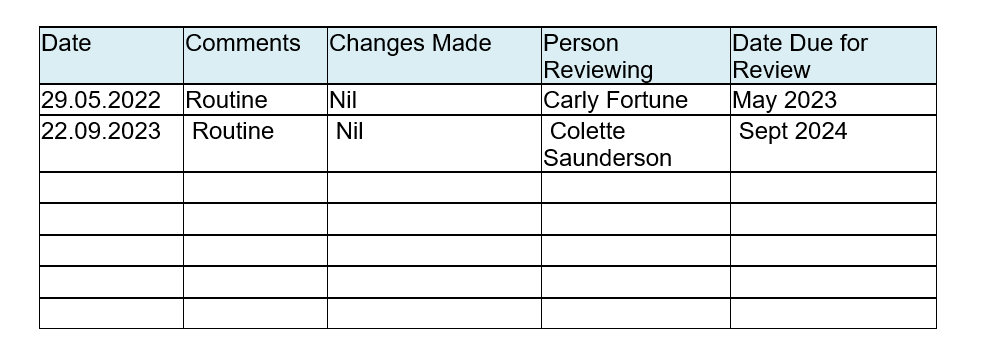
Date Reviewed: May 2021
Person responsible for updating this policy: Carly Fortune
Next Review Date: May 2022