Scope
Policy Statement
- Care Act 2014
The Policy
- Penalties (Individuals)
- Penalties (Organisation)
Related Policies
Related Guidance
Training Statement
Policy Statement
As part of the Criminal Justice and Courts Act 2015, two criminal offences have been introduced into the health and social care legislative framework. These offences cover both staff and the organization itself, with directors and senior managers being made accountable in a way not seen before in the adult sector.
Care Act 2014
Within the safeguarding statutory guidance issued under this Act, there is a thorough explanation of the process regarding criminal offence and adult safeguarding in Chapter 14.70–14.76. This includes things such as:
- Special measures.
- Vulnerable adult witnesses.
- Intimidated witnesses
Although the local authority has the lead role in making enquiries, where criminal activity is suspected, the early involvement of the police is likely to be of benefit in many cases. It is therefore imperative that all managers are aware of this guidance, concerning adult safeguarding and to these separate offences
The Policy
Note: A higher standard of proof is required in criminal proceedings (beyond reasonable doubt) than in disciplinary or regulatory proceedings (where the test is the balance of probabilities) and so early contact with the police may assist in obtaining and securing evidence, witness statements, and assist with ensuring forensic evidence is not lost or contaminated.
These regulations apply to:
- All formal healthcare provision for adults and children on both the NHS and private sector other than in specific excluded children’s settings and services which are already subject to comprehensive legislative and regulatory safeguards.
- All formal adult social care provision in both the public and private sectors, including where care is self-funded.
- To individuals and organisations paid to provide or arrange for the provision of these health and adult care services, but with the offence for organisations formulated differently from that for individuals.
Penalties (Individuals)
These will mirror those attached to the offence of ill-treatment or wilful neglect of persons without capacity set out in section 44 of the Mental Capacity Act 2005.
For the individual, the offences will focus on their conduct.
Penalties (Organisation)
For organisations, a variety of penalties are in place which includes fines, the issuing of publicity orders and remedial orders which will be similar to those available in respect of convictions of corporate manslaughter in the Corporate Manslaughter and Corporate Homicide Act 2007.
For organisations such as ours, the offence will focus on the formulation of the corporate manslaughter offence. In essence, the business can be prosecuted if how its activities are managed or organised by senior management causes ill treatment or wilful neglect to occur, causing a gross breach of a duty of care.
The Care Quality Commission will issue further guidance and this policy will be amended to reflect such guidance. As an organisation which delivers good consistent levels of quality services to our service-users, the following has been put into place to reflect the serious nature of any situation which would be deemed to be within this policy’s remit.
The registered manager must report, without delay, any situation where a corporate manslaughter offence could be considered the outcomeThis will be communicated by telephone, or, in person whichever is the most expedient. Contemporaneous Records must be taken, and the designated postholder then has the responsibility to take the appropriate steps, in conjunction with multi-agency partners, where appropriate, whilst adhering to the organisation’s policies and procedures. The senior management team will be fully briefed and updated by the postholder. This policy will be updated and revised to reflect any changes to regulatory guidance on an as and when required basis until all the legal requirements are agreed, and in law.
Related Policies
Adult Safeguarding
Duty of Candour
Good Governance
Related Guidance
Criminal Justice and Courts Act 2015: http://www.legislation.gov.uk/ukpga/2015/2/part/1/crossheading/offences-involving-illtreatment-or-wilful-neglect/enacted
Training Statement
All managers will have a though knowledge of this policy and understand the importance of swift and appropriate reporting and actions. All staff, during induction, are made aware of the organisation’s policies and procedures, all of which are used for training updates. All policies and procedures are reviewed and amended where necessary, and staff are made aware of any changes. Observations are undertaken to check skills and competencies. Various methods of training are used, including one to one, online, workbook, group meetings, and individual supervisions. External courses are sourced as required.
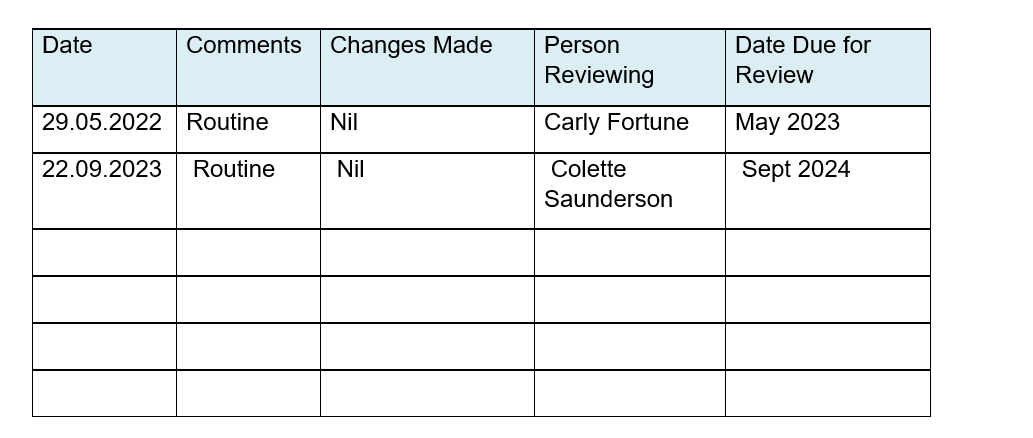
Date Reviewed: May 2021
Person responsible for updating this policy: Carly Fortune
Next Review Date: May 2022