Scope
- Policy Statement
- The Policy
- Aim of the Complaints Procedure
- Responsibilities
- Complaints Procedure
- Vexatious Complainers
- Local Government Ombudsman (LGO)
- Local Authority-funded Service Users
- Relevant Contacts
- Related Policies
- Related Guidance
- Training Statement
Policy Statement
This organisation’s policy is intended to comply with Regulation 16 of the Fundamental Standard Regulations.
This organisation accepts the rights of service users to make complaints and to register comments and concerns about the services received. It further accepts that they should find it easy to do so. It welcomes complaints, seeing them as opportunities to learn, adapt, improve, and provide better services.
The Policy
This policy is intended to ensure that complaints are dealt with properly and that all complaints or comments by service users and their relatives, carers, and advocates are taken seriously. It is not designed to apportion blame, to consider the possibility of negligence, or to provide compensation. It is not part of the company’s Disciplinary Policy. This organisation believes that failure to listen to or acknowledge complaints leads to an aggravation of problems, service user dissatisfaction, and possible litigation. The organisation supports the idea that most complaints if dealt with early, openly, and honestly, can be sorted at a local level between just the complainant and the organisation. The complaints procedure is made available to service user and families in their Service User Guide. A copy is always kept in their care plan in their homes and available in a format that can be understood.
ADASS has published a Good Practice Guide on Handling Complaints concerning Adults and Children in Social Care Settings. They have identified the following five principles:
- Ensure that the complaints process is accessible.
- Ensure that the complaints process is straightforward for service users and their representatives.
- Ensure that an appropriate system is in place to keep service users informed throughout the complaints process.
- Ensure that the complaints process is resolution focused.
- Ensure that quality assurance processes are in place to enable organisational learning and service improvement from complaints and customer feedback.
Aim of the Complaints Procedure
We aim to ensure that the complaints procedure is properly and effectively implemented and that service users feel confident that their complaints and worries are listened to and acted upon promptly and fairly. Specifically, we aim to ensure that:
This policy aims to help the service user, through the use of advocacy, to express their views, both to the organisation and other bodies, and to feel that their views are understood and respected.
- Service users, carers, and their representatives are aware of how to complain, and that the company provides easy-to-use opportunities for them to register their complaints.
- A named person will be responsible for the administration of the procedure.
- Every written complaint is acknowledged within five working days.
- All complaints are investigated within 14 days of being made.
- All complaints are responded to in writing within 28 days of being made.
- Complaints are dealt with promptly, fairly and sensitively, with due regard to the upset and worry that they can cause to both residents and staff.
Responsibilities
The registered manager is responsible for following through with complaints. However, there may be a specific post with responsibility for complaints. Communication between this post and the registered manager should be clear and transparent so that the registered manager can demonstrate and evidence of compliance. Thhe post holder will be Colette Saunderson.
Complaints Procedure
Verbal Complaints
- The organisation accepts that all verbal complaints, no matter how seemingly unimportant, must be taken seriously.
- Front-line care staff who receive a verbal complaint are expected to seek to solve the problem immediately.
- If they cannot solve the problem immediately, they should offer to get their line manager to deal with the problem.
- Staff are expected to remain polite, courteous, sympathetic, and professional to the complainant. They are taught that there is nothing to be gained by adopting a defensive or aggressive attitude.
- At all times in responding to the complaint, staff are encouraged to remain calm and respectful.
- Staff should not make excuses or blame other staff.
- If the complaint is being made on behalf of the service user by an advocate, it must first be verified that the person has permission to speak for the service user, especially if confidential information is involved. It is very easy to assume that the advocate has the right or power to act for the service user when they may not. If in doubt, it should be assumed that the service user’s explicit permission is needed before discussing the complaint with the advocate.
- After discussing the problem, the manager or member of staff dealing with the complaint will suggest a means of resolving it. If this course of action is acceptable, the member of staff should clarify the agreement with the complainant and agree on a way in which the results of the complaint will be communicated to the complainant (i.e., through another meeting or by letter).
- If the suggested plan of action is not acceptable to the complainant, the member of staff or manager will ask the complainant to put their complaint in writing to the registered manager. The complainant should be given a copy of the company’s complaints procedure if they do not already have one.
- Details of all verbal and written complaints must be recorded in the complaints book, the service user’s file, and in the home records.
Serious or Written Complaints
Preliminary steps:
- When we receive a written complaint, it is passed to the designated lead manager, who records it in the complaints book and sends an acknowledgement letter within five working days to the complainant.
- With this letter, the manager also includes a leaflet detailing the organisation’s procedure for the complainant. (Designated lead is the named person who deals with the complaint through our process.)
- If necessary, further details are obtained from the complainant. If the complaint is not made by the service user but on the service user’s behalf, the consent of the service user, preferably in writing, must be obtained from the complainant where required.
- If the complaint raises potentially serious matters, advice could be sought from a legal advisor. If legal action is taken at this stage, any investigation by the organisation under the complaints procedure ceases immediately.
- Investigation of the complaint by the organisation:
- Immediately on receipt of the complaint, the complaints manager will start an investigation and, within 14 days, should be in a position to provide a full explanation to the complainant, either in writing or by arranging a meeting with the individuals concerned.
- If the issues are too complex for the investigation to be completed within 28 days, the complainant will be informed of any delays.
- Where the complaint cannot be resolved between the parties, an arbitration service will be used. This service and its findings will be final to both parties. The cost of this will be borne by the organisation.
Meeting:
- If a meeting is arranged, the complainant will be advised that they may, if so desired, bring a friend, relative, or a representative, such as an advocate.
- At the meeting, a detailed explanation of the results of the investigation will be given, in addition to an apology, if deemed appropriate (an apology is not necessarily an admission of liability).
- Such a meeting allows the management to show the complainant that the matter has been taken seriously and investigated thoroughly.
Follow-up action:
- After the meeting or if the complainant does not want a meeting, a written account of the investigation will be sent to the complainant. This includes details of how to approach the CQC, if the complainant is not satisfied with the outcome, utilising the Your Experience button on their website.
- The outcomes of the investigation and the meeting are recorded in the complaints book and any shortcomings in company procedures will be identified and acted upon.
- The company management formally reviews all complaints at least every six months as part of its quality monitoring and improvement procedures to identify the lessons learned.
Vexatious Complainers
This organisation takes seriously any comments or complaints regarding its service. However, there are service users who can be treated as ‘vexatious complainers’ due to the inability of the organisation to meet the outcomes of the complaints, which are never resolved. Vexatious complainers need to be dealt with by the arbitration service so that the repeated investigations become less of a burden on the organisation, its staff, and other service users.
Local Government Ombudsman (LGO)
Since October 2010 the Local Government Ombudsman (LGO) can consider complaints from people who arrange or fund their own adult social care. This is in addition to complaints about care arranged and funded by local authorities (LAs), which the LGO has dealt with for more than 35 years.
The LGO’s role includes those who self-fund from their resources or have a personalised budget. It will ensure that everyone has access to the same independent ombudsman service, regardless of how the care service is funded. In most cases, they will only consider a complaint once the care provider has been given a reasonable opportunity to deal with the situation. It is a free service. Its job is to investigate complaints fairly and independently; it is not biased and does not champion complaints; it is independent of politicians, LAs, government departments, advocacy and campaigning groups, the care industry, and the CQC; it is not a regulator, and it does not inspect care providers.
The LGO is fully independent of the CQC. It deals with individual injustices that people have suffered, and the CQC will refer all such complaints to them. The CQC deals with complaints about registered services as a whole and does not consider individual matters. They can share information with the CQC but only when deemed appropriate. The CQC will redirect individual complaints to the LGO, and the LGO will inform the CQC about outcomes that point to regulatory failures.
Local Authority-funded Service Users
Any service user part or wholly funded by their LA can complain directly to the complaints manager (adults) who are employed directly via the LA.
Relevant Contacts
Local Authority Complaints Manager (Adults):
Comments, Compliments and Complaints
FREEPOST RLTX-LBXU-SHBS
County Hall
Morpeth
Northumberland NE61 2EF
01670 628888
socialcarecomplaints@northumberland.org.uk
Social Services Local Office:
Eddie Ferguson House
Ridley Street
Blyth
Northumberland. NE24 3AG
01670 536400
County Hall
Morpeth
Northumberland. NE61 2EF
01670 536400
Alnwick Fire Station
Blackthorn Close
Alnwick
Northumberland. NE66 2ER
01670 536400
County Police HQ:
Northumbria Police HQ
Middle Engine Lane
Wallsend
Tyne and Wear
NE28 9NT
Landline: 0191 214 6555/01661 872555
The Parliamentary and Health Service Ombudsman
Millbank Tower
Millbank
London, SW1P 4QP
Tel. 0345 015 4033
The Local Government Ombudsman
10th Floor, Millbank Tower,
Millbank,
London, SW1P 4QP
Advice Line Tel: 0300 061 0614 [for complainants]
Out of Hours Service (Social Services) – available when social services offices are closed:
Emergency Duty Team
01670 536400
To raise concerns, contact:
The Care Quality Commission
Citygate
Gallowgate
Newcastle upon Tyne
NE1 4PA
Tel. 03000 616161
The CQC will take details of concerns and respond appropriately and proportionately to the information divulged.
Related Policies
Accessible Information and Communication
Adult Safeguarding
Consent
Dignity and Respect
Duty of Candour
Good Governance
Related Guidance
Resources and guidance for Social Care providers:
https://www.lgo.org.uk/adult-social-care/resources-for-care-providers
Concerns about a care service:
https://www.scie.org.uk/
CQC Regulation 16: Receiving and acting on complaints:
https://www.cqc.org.uk/guidance-providers/regulations-enforcement/regulation-16-receiving-acting-complaints
CQC Complaints Matter:
https://www.cqc.org.uk/sites/default/files/20141208_complaints_matter_report.pdf
CQC Regulation 20: Duty of Candour:
https://www.cqc.org.uk/guidance-providers/regulations-enforcement/regulation-20-duty-candour
Local Government and Social Care Ombudsman Annual Review of Complaints:
https://www.lgo.org.uk/information-centre/reports/annual-review-reports
Local Government and Social Care Ombudsman: How to Complain:
https://www.lgo.org.uk/make-a-complaint
Training Statement
All staff, during induction, are made aware of the organisation’s policies and procedures, all of which are used for training updates. All policies and procedures are reviewed and amended where necessary, and staff are made aware of any changes. Observations are undertaken to check skills and competencies. Various methods of training are used, including one to one, online, workbook, group meetings, and individual supervisions. External courses are sourced as required.
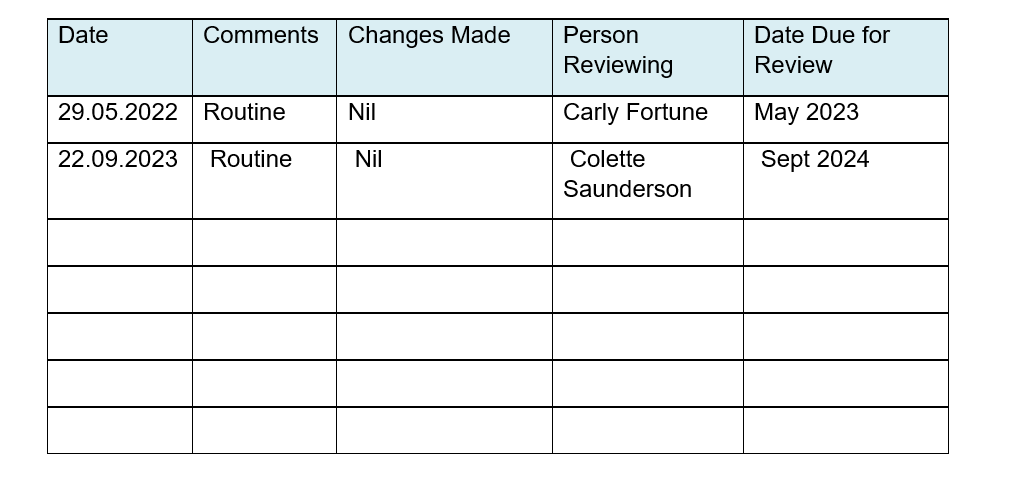
Date Reviewed: May 2021
Person responsible for updating this policy: Carly Fortune
Next Review Date: May 2022