

Terrorism and Radicalisation including
PREVENT
The Counter-Terrorism and Security Act 2015 became law in February 2015. It introduced a raft of measures, some of which are still being debated in parliament. The terrorism threat to the UK is considerable, and the government has acted to ensure that the intelligence agencies have the powers they need to keep us safe; it has issued statutory guidance to all relevant specified authorities.
Schedule 6 List
This list, which is regularly reviewed, includes all local authorities (LAs); anyone on the list is known as a ‘specified authority’. It also includes prison, health and social care, education, and police personnel at an identified level, for instance, a chief officer of police. The Act creates a general duty of ‘due regard’ on all ‘specified authorities’.
LAs must have due regard to local circumstances; give appropriate weight to the need to prevent people from being drawn into terrorism (see below), and consider all other factors relevant to how they carry out their usual functions.
The Prevent Strategy
This includes clarification of the Prevent Strategy first identified in 2011, which is a part of CONTEST, the government’s counter-terrorism strategy. CONTEST is made up of four workstreams, each comprising a set of objectives:
Pursue: to stop terrorist attacks,
Prevent: to stop people from becoming terrorists or supporting terrorism,
Protect: to strengthen our protection against a terrorist attack,
Prepare: to mitigate the impact of the terrorist attack
This policy is intended to make staff aware of their role and responsibilities regarding the Prevent Strategy work, as required by the legislation.
Prevent Strategy Objectives
The Prevent Strategy aims to perform the following:
- Respond to the ideological challenge of terrorism and the threat posed by those who promote it.
- Prevent people from being drawn into terrorism and ensure they are given the appropriate advice and support.
- Work with sectors and institutions where there are risks of radicalisation that we need to address.
Since the 2011 Prevent Strategy, the government has defined extremism as “a vocal or active opposition to fundamental British values, including democracy, the rule of law, individual liberty and mutual respect and tolerance of different faiths and beliefs”; also included in their definition are “any calls for the death of members of the armed forces”.
The Prevent Strategy was explicitly changed in 2011 to counter all forms of terrorism, including non-violent extremism, that create an atmosphere conducive to terrorism or that popularise views that can then be exploited by terrorists. The changes also made clear that preventing people from becoming terrorists or supporting terrorism requires challenging extremist ideas where they are used to legitimise terrorism and are shared by terrorist groups. The strategy also means intervening to stop people moving from extremist (albeit legal) groups into terrorist-related activity.
Prevent Strategy work is intended to deal with all kinds of terrorist threats to the UK. Currently, the most significant threats are from terrorists’ functioning in Syria and Iraq, including Al Qa’ida associate groups, ISIS (also Daesh); however, right-wing extremists also pose a threat to our safety and security. In fulfilling the Prevent Strategy duty, all specified authorities are expected to participate fully in work to prevent people from being drawn into terrorism. Specified authorities in Schedule 6 of the Act are those judged to have a role in protecting vulnerable people and/or our national interest and security.
PREVENT aims to safeguard people and communities from the threat of terrorism. Prevent is no different from any other form of safeguarding from harm.
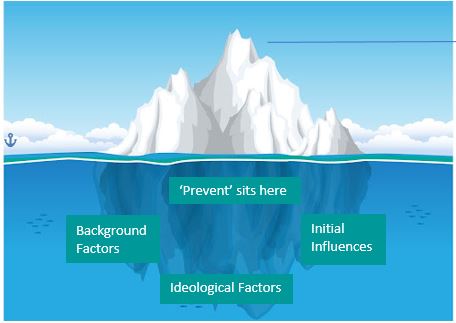
Tip of Iceberg
The part above the surface which we see.
The actual terrorist attack.
Below the surface
- Criminal Acts
- Hoovering/Gaining weapons
- Raising Funds
- Finding Somewhere to Target
- Radicalisation
Identifying individuals vulnerable to risk of radicalisation
There is no single way of identifying who is likely to be vulnerable to being drawn into terrorism. Factors that may have a bearing on someone becoming vulnerable may include:
- peer or family pressure
- influence from other people or via the internet
- bullying
- being a victim or perpetrator of crime
- anti-social behaviour
- family tensions
- hate crime
- lack of self-esteem or identity
- personal or political grievances
What to look out for
Indicators people may be ‘vulnerable to being drawn into terrorism’ While not exhaustive, this could include cases where individuals:
- peer or family pressure
- influence from other people or via the internet
- bullying
- being a victim or perpetrator of crime
- anti-social behaviour
- family tensions
- hate crime
- lack of self-esteem or identity
- personal or political grievances
What can you do?
You should ensure you understand what radicalisation means and why people may be vulnerable to being drawn into terrorism as a consequence of it.
Make sure you are aware of what is meant by the term ‘extremism’ and the relationship between extremism and terrorism.
You need to know what measures are available to stop people from becoming drawn into terrorism and how to challenge the extremist ideology that can be associated with it. You need to understand how to obtain support for people who may be being exploited by radicalising influences.
About Us
Are you concerned about a service user or member of staff? Perhaps you’ve noticed a change in behaviour; are they becoming withdrawn, or acting differently? Maybe it’s something the individual has said that’s worrying you. Support workers will often be the first to notice if a student is experiencing difficulties.
Check
Don’t ignore your concerns – check with others who may also have noticed something. You could speak to the individual directly, or talk to colleagues/academic tutors, to see if they share your concerns.
Share
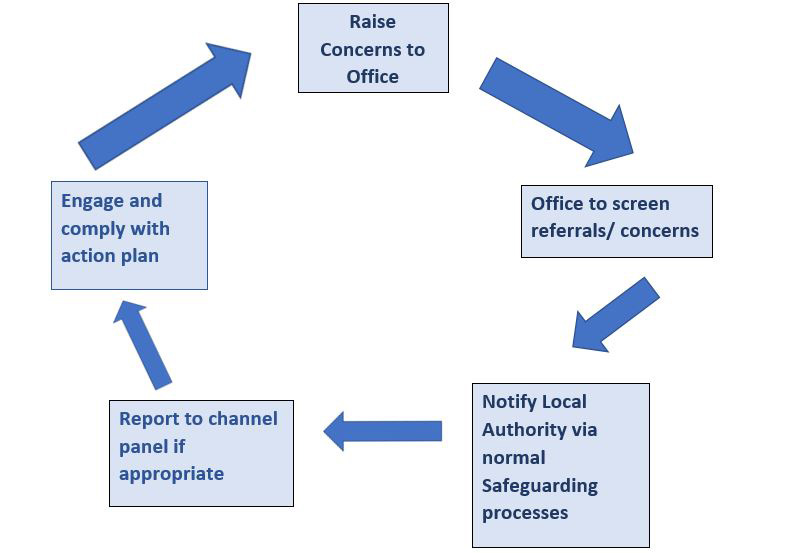
If you are still worried about an individual, contact the office to share your concerns. The team may be able to offer support and guidance to the individual. If you are unsure about what might happen next, please refer to the Escalation Procedure below.
Escalation Procedures
Channel
What is it?
A multi-agency early intervention process designed to safeguard vulnerable people from being drawn into violent extremist or terrorist behaviour; works in a similar way to safeguarding adults boards (SABs).
It works to recognise when people may becoming drawn into violent extremist or terrorist behaviour and to intervene early to attempt to prevent it.
Who does it work with?
Individuals of any age are at risk of being exploited by extremists or terrorist ideologies. It provides support for tackling any form of radicalisation or personal vulnerabilities.
The Channel Panel
Each panel is chaired by a LA and brings together a range of multi-agency partners to collectively assess the risk; they decide whether a support package is needed.
Raising a Concern
If staff believe that someone vulnerable is being exploited or radicalised then the established safeguarding procedures within the company should be used to escalate concerns, this can be done via telephone, email or the form at the end of this page; this can then raise concerns with Channel, if appropriate. Channel will then monitor the situation and put in plans to support the individual and manage and risk of terrorist behaviour.
The metropolitan police have more information on how and when to report terrorism. It also talks about how to spot suspicious activity when out and about. It is available at the below:
Staying safe from terrorism | Metropolitan Police
If you have a concern relating to PREVENT please consider if this is an emergency which needs to be dealt with immediately, this could be suspicious behaviour, a package or vehicle acting suspiciously, if so ring 999.
If you’re suspicious of something that could identify a terrorist threat anywhere in the UK, report it using the metropolitan police quick and confidential online tool to report possible terrorist activity, or call the Anti-Terrorism Hotline on 0800 789 321. If you do this please make us aware so we can ensure safety measures are put in place to keep all staff and service users safe until investigated and action taken.
Even if you’re not sure or it seems trivial, please let the police know. They have specially trained officers available 24/7 and will look into every call or online report.
A textphone service is available for people with speech or hearing difficulties on 0800 0324539 (text messages from mobiles are not accepted).
Training
All specified authorities subject to the duty will need to ensure they provide appropriate training for staff involved in the implementation of this duty; such training is now widely available.
Please complete the below Home Office e-learning (3 modules) and forward your certificate to the office for your training file.
https://www.elearning.prevent.homeoffice.gov.uk
http://www.elearning.prevent.homeoffice.gov.uk/preventreferrals
http://www.elearning.prevent.homeoffice.gov.uk/channelawareness